Yarutka field
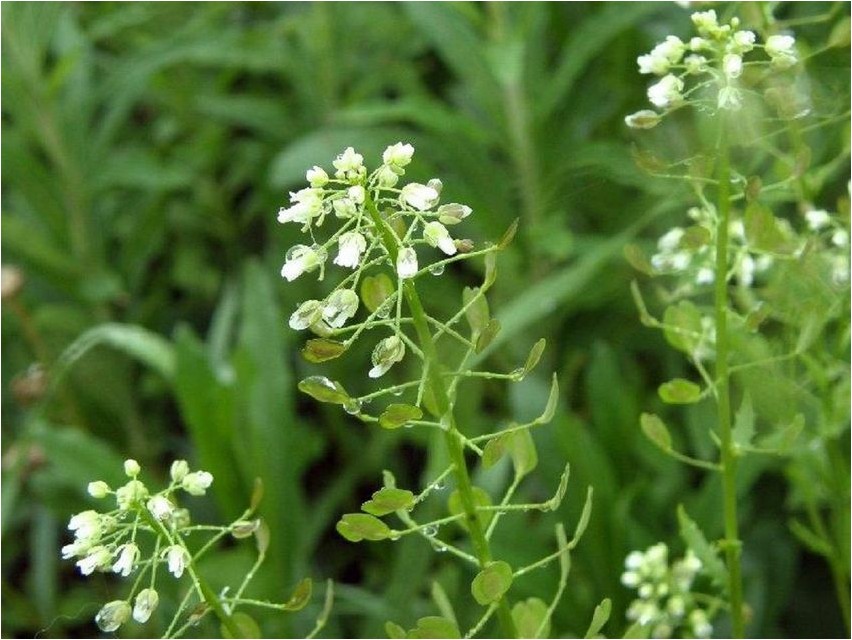
Field jar (lat. Thlaspi arvense) – unlike its many relatives in the Brassica family, which are biennial plants, Field jar is a herbaceous annual.
The simple appearance of the plant and its unpretentiousness to living conditions often turn Yarutka field into a weed that grows in vacant lots, dusty roadsides, and also interferes with the growth of grain crops. People familiar with its healing abilities and nutritional benefits treat the plant with great respect and reverence.
What’s in your name
In addition to the Latin name, which is interpreted in Russian as Field Jarutka, the plant has many popular names, since its ubiquity makes this possible.
Its oval fruit-pods look like coins, and therefore give rise to such names as “penny”, “money”. Some people associate the plant with a harmful insect, and they call the field grass “bug” or “bedbug”. The paniculate inflorescence gives birth to the name “broom”. In addition, Yarutka is called: “vertebra”, “splinter”, “toad grass”..
Description
Depending on the conditions of life, Field grass can grow to a height of 10 to 80 cm.
Its simple or branched stems are covered with sessile, arrow-shaped leaves with a sparsely toothed edge. The basal rosette is formed by petiolate leaves, oval or oblong-oval.

Small four-petaled white flowers are surrounded by four green sepals. In the center of the flower there is a pistil surrounded by six stamens. To make the flowers more noticeable, they are collected in inflorescences of racemes or panicles.
The fruits, called “flattened pods” by experts, turn Yarutka arvensis into a “money herbaceous plant”, on which hang brown-green coins filled with numerous small seeds. One such plant produces up to ten thousand seeds in one summer period. With such fertility, competitors are not scary.
Healing components
Plants of the Brassica family are famous for their high content of ascorbic acid. Field grass maintains this family tradition, and therefore its leaves and seeds are also rich in vitamin C. So, young greens can be added to salads that need this vitamin.
Seeds of Field Jarutka are a real storehouse of substances useful to humans. There is a glycoside present here that helps the heart function properly; lecithin, which supports the nervous system and liver function; protein body – myrosin; sinigrin, which gives the plant a mustard smell; fatty oil.
Healing abilities
With such diverse reserves of useful components, field grass cannot be an unclaimed plant for healers of the human body and soul.
From the grass collected during the flowering period of the plant, and the seeds collected when ripening, potions are prepared that have a number of actions to maintain the human body in a healthy state.
They actively resist microbes, relieve inflammation, help relieve coughs, have diaphoretic and diuretic effects, can stop bleeding, and also heal cuts and wounds on the skin in a short time.
They write that the juice of the plant can remove warts on the skin.
Traditional healers use Yarutka to heal much more serious problems: atherosclerosis, diabetes, male impotence, scarlet fever, jaundice and many others.
Use in cooking
Rich in vitamin C, the fresh leaves of the field plant are an excellent component of any salad, especially in early spring. Russian cabbage soup will become much more vitamin-rich if you add young leaves of the field plant to them.
The presence of sinigrin in the seeds of Yarutka arvensis, a source of mustard odor, turns the seeds into a competitor for mustard. In the absence of the latter, you can use the seeds of the field plant, giving the meat dish a pleasant spiciness.
Contraindications
No matter how good the field jar is, pregnant women are not recommended to abuse its benefits.





