Alfalfa crescent
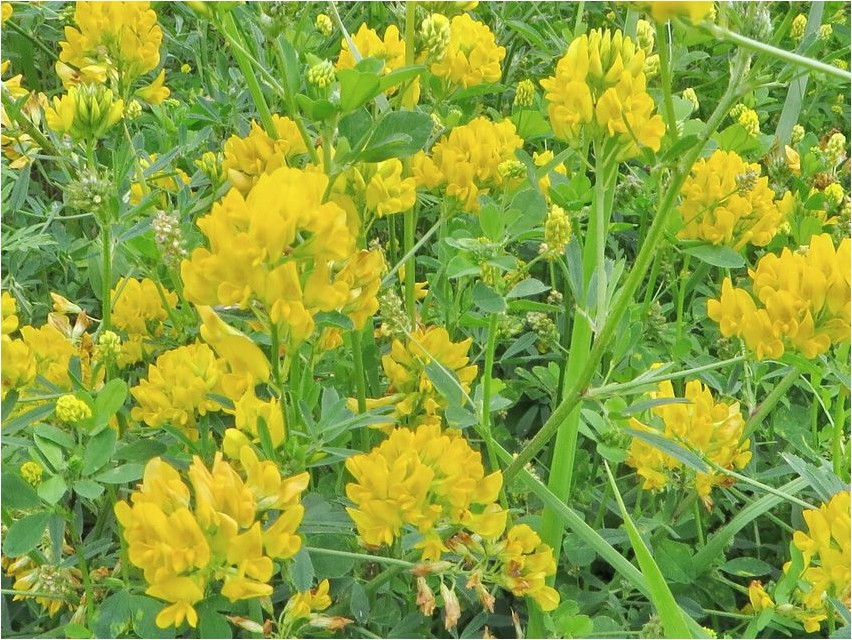
alfalfa crescent is one of the plants of the family called legumes; in Latin the name of this plant will be as follows: Medicago falcata L.
As for the name of the crescent alfalfa family itself, in Latin it will be: Fabaceae Lindl. (Leguminosae Juss.).
Description of sickle alfalfa
Crescent alfalfa is a perennial herbaceous plant endowed with a tap root system, but under certain conditions the formation of rhizomes of different lengths, or even root suckers, may occur. The stems of this plant can be either ascending or straight, and the height of the stems of crescent alfalfa will fluctuate between thirty and eighty centimeters. At the very base, such stems are branched and heavily leafy. The leaves of this plant are trifoliate, they are endowed with obovate leaves, the length of which reaches two centimeters and the width does not exceed one centimeter. Also, such leaves will be endowed with petioles; lanceolate, serrated and sometimes entire stipules are attached to their base. Crescent alfalfa flowers are collected in groups of about twenty to thirty pieces in short oval and sometimes even capitate racemes, which will emerge from the axils of the middle and upper leaves of the shoot. Crescent alfalfa flowers are endowed with a tubular-funnel-shaped calyx, all five teeth of which will be equal in length to the tube itself. The corolla of this plant is typically moth-type, its length reaches ten centimeters, such a corolla will be colored yellow. This plant has only ten stamens, nine of them are fused with filaments, and there will be one pistil with the upper ovary. Sickle alfalfa pods will be sickle-shaped and may be slightly hairy or bare. The seeds of this plant will be bean-shaped or ovoid in shape, their length reaches approximately two millimeters and the width is one and a half millimeters; the color of such seeds can be either brown or yellow.
Crescent alfalfa blooms in the summer. Under natural conditions, this plant is found in all regions of the European part of Russia, with the exception of the Far North, as well as in Ukraine, Kazakhstan, Central Asia, the Caucasus, in the southern regions of Siberia and the Far East. For growth, this plant prefers steppes, fields, forest edges, various meadows, as well as roadsides. It is noteworthy that this plant was introduced into cultivation.
Description of the medicinal properties of sickle alfalfa
Crescent alfalfa is endowed with very valuable healing properties, and it is recommended to use the herb of this plant for medicinal purposes. The presence of such valuable healing properties should be explained by the content of coumestrol, ascorbic acid, saponins and coumarin compounds in the herb of this plant. The herb of this plant is recommended to be used to obtain a multivitamin concentrate, which will contain carotene, vitamin K and ascorbic acid.
As for Tibetan medicine, here healing remedies based on this plant are very widespread. The herb sickle-shaped alfalfa is used to treat pneumonia, abscesses, gastrointestinal diseases, kidney diseases, hemoptysis, increased heartbeat. It is noteworthy that in the composition of the preparations, the herb of this plant is used as an anti-inflammatory agent.

An infusion or decoction based on the roots of this plant is recommended for use as a sedative. In Belarus, an aqueous decoction of sickle alfalfa is used to treat nervous disorders and is also used as an anti-carcinogenic agent.





