Jaundice yellow
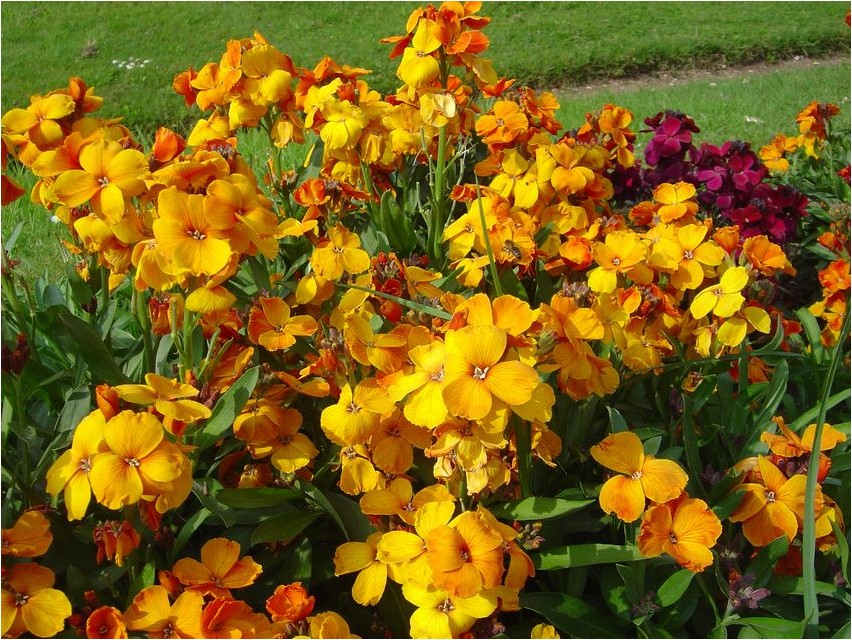
Yellow jaundice is one of the plants of the family called cruciferous; in Latin the name of this plant will be as follows: Erysimum flavum.
As for the name of the yellow jaundice family itself, in Latin it will be: Brassicaceae Burnett.
Description of yellow jaundice
Yellow jaundice is a perennial low herbaceous fragrant plant, the height of which will be about twenty to fifty-five centimeters. The plant will be endowed with a more or less thick rhizome. The leaves of this plant are painted in gray tones; they will be linear-oblong in shape. The brush is compressed, and then it will be elongated. The length of the sepals is about seven to eight and a half millimeters, the petals are colored gray-yellow, and their length is twelve to eighteen millimeters. The petal plates are almost rounded, the nail is longer than the calyx, and is also long and narrow. The pods are quite thick and erect, and the seeds of the yellow jaundice are brown in color and will be oblong in shape.
The flowering of yellow jaundice occurs from May to July. Under natural conditions, the plant is found in Central Asia, the Altai and Irtysh regions of Western Siberia, as well as in the following regions of Eastern Siberia: the Daursky and Angaro-Sayan regions.
Description of the medicinal properties of yellow jaundice
Yellow jaundice is endowed with very valuable healing properties, and it is recommended to use the grass and flowers of this plant for medicinal purposes. The term grass includes leaves, stems and flowers.
The presence of such valuable medicinal properties is due to the content of vitamin C and organic acids in the plant, and the herb of this plant contains cardenolides and vitamin C. It is noteworthy that it has been proven that the seeds will contain sulfur-containing compounds. As for traditional medicine, here this plant is considered very effective in curing diseases of the heart, blood and lungs, as well as in the treatment of smallpox and when used as an antipyretic.

It is noteworthy that in Siberia, an infusion of the herb of this plant is used as a diuretic and cardiotonic. Infusion and wine tincture of the yellow jaundice herb is also used to treat headaches. The flowers of this plant can be used for poisoning, and also as an antipyretic. The flowers of the yellow jaundice are endowed with very high cardiotonic activity, which will exceed the activity of the leaves of the foxglove. The purified extract in the form of an alcohol solution can exhibit an effect that will be approximately equal to the effect of strophanthus tincture.
It should be noted that the biological activity of preparations prepared from the seeds of this plant exceeds that of foxglove leaves. It is also important to remember that preparations based on yellow jaundice must be used only under the direct supervision of a doctor.
For migraines, you should use a fairly effective remedy based on this plant: to prepare such a remedy, take one teaspoon of crushed herb per two glasses of boiling water. The resulting mixture should be infused for two hours, and then the mixture should be carefully filtered. Take this remedy one tablespoon three times a day.
It is recommended to use the following remedy as an antipyretic: to prepare it, take one teaspoon of the flowers of this plant in two glasses of boiling water. This mixture is infused for two hours and filtered thoroughly. Take this remedy one tablespoon three times a day.





