Fieldfare
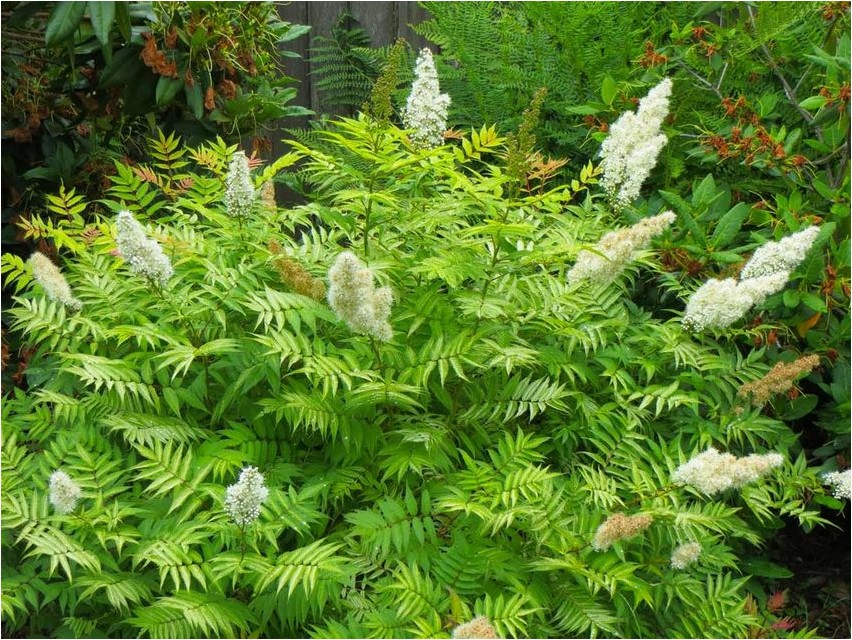
Fieldfare (lat. Sorbaria) is a genus of shrubs of the Rosaceae family. Natural range — Asia. The genus got its name from the Latin “sorbus”, which translates as “rowan”, and this is due to the fact that the leaves of most types of mountain ash are similar to the leaves of the common mountain ash. Today there are 10 species.
Characteristics of culture
Fieldfare is a deciduous shrub up to 3 m high, forming abundant and very spectacular thickets due to its strong root-sprouting ability. The shoots are geniculate-twisting, yellowish-gray in color. The leaves are large, graceful, compound, double-serrate, odd-pinnate.
The flowers are small, numerous, creamy white or white, collected in large paniculate inflorescences of a conical or pyramidal shape. The fruit is a leaflet. Fieldfare is characterized by rapid growth, unpretentiousness and long flowering, which lasts about a month.
Growing conditions
Fieldfare is not picky about soil conditions, although more decorative forms can only be obtained on moist, loose, well-drained soils. It does not accept crops of saline, heavily waterlogged, dry, compacted and acidic soils, as well as low-lying areas with stagnation of cold air or melt water. Light shading is not prohibited, sunny areas are welcome. Otherwise, the culture does not make any special demands.
Reproduction
Fieldfare is propagated by seeds, cuttings and root suckers. Seeds are sown in the spring without preliminary stratification and other preparatory treatments, but experienced gardeners advise carrying out two-month stratification, which will speed up the emergence of seedlings.
The simplest and most common method of propagation is propagation by root suckers. The root system of fieldfare is shallow, and it is quite easy to obtain offspring. Having cut through the rooted shoot with a shovel, the material is immediately planted in the prepared soil. Fieldfare grown in this way bloom in the second or third year, which is a definite plus. Cuttings are a more labor-intensive method, so they are used extremely rarely, just like seed ones.

Care
Caring for fieldfare consists of standard procedures, that is, weeding and loosening the tree trunk area, watering and fertilizing. It is also necessary to systematically remove faded panicles, although this requirement is not necessary.
Sanitary and formative pruning is carried out in the spring; in this way you can get rid of broken, thickening, diseased and frozen branches. Old branches that become bare over time are also removed or pruned to allow for strong growth. It is better to limit the development of the root system, otherwise it can grow over long distances and thereby crush other crops.
Application
Fieldfare attracts attention with its openwork spreading crown, foliage color and lush flowering panicles. Plants are used in group and single plantings, to secure ravines and slopes, to create undergrowth and forest edges. In landscape design, only two species have become widespread — Pallas”s fieldfare and mountain ash.
The crop can be grown in close proximity to fences and walls of houses. Fieldfare also looks quite harmonious as a hedge. Plants look great in gardens. Faded panicles of fieldfare can be used to make winter bouquets.
The culture is also used for medicinal purposes. The leaves and flowers of the plant contain traces of coumarins, phenylethylamine and flavonoids. Fieldfare roots are rich in essential oil. In folk medicine, infusions of leaves, flowers and roots are used as an antirheumatic agent. Fieldfare decoctions are useful for internal and uterine bleeding.





