Magnolia obovate
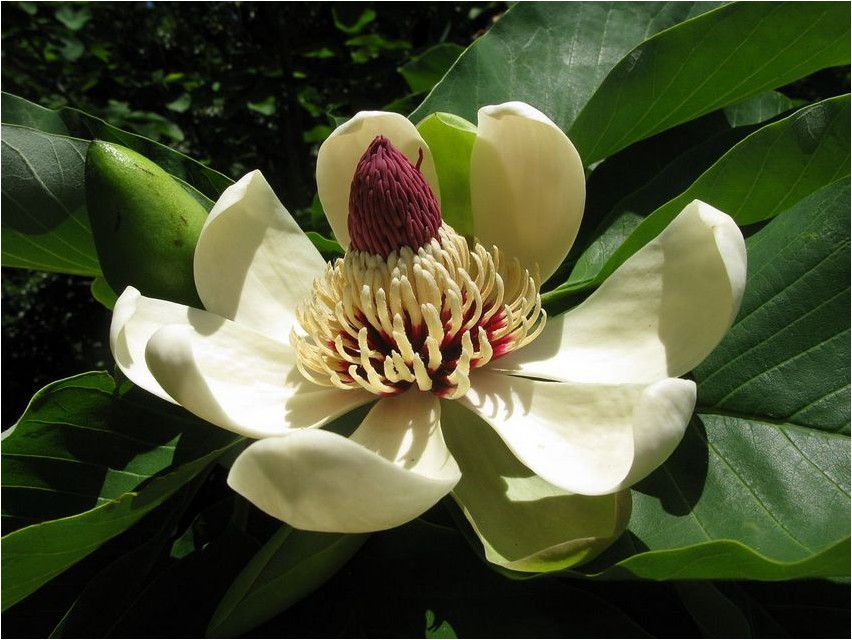
Magnolia obovata is one of the plants of the family called Magnoliaceae; in Latin the name of this plant will be as follows: Magnolia obovata Thunb.
As for the name of the magnolia obovate family itself, in Latin it will be: Magnoliaceae Juss.
Description of magnolia obovate
Magnolia obovate is a tree whose height will be about six to eight meters, and its diameter will range between fifteen and forty centimeters. It is noteworthy that in Japan the height of this plant will be thirty meters, and the diameter will be approximately sixty to seventy centimeters. The bark of the trunk of this plant will be painted in gray tones, it is endowed with rather short longitudinal cracks. Young shoots of Magnolia obovate are pubescent, while adult shoots will be either bare or pubescent along the veins. The length of the leaf petioles of this plant is about two to five centimeters. Magnolia obovate flowers are quite large in size, they are endowed with a strong scent and are colored creamy white. The stamens of this plant are numerous, they are collected into a fairly large cone, the length of which will not exceed thirteen centimeters, and the diameter will be approximately four and a half centimeters. Magnolia obovate seeds will be compressed and ovoid, and their length is one centimeter. The flowering of this plant begins in early July, while the seeds will ripen already in the period from the end of August to the beginning of September.
Under natural conditions, this plant is found on the territory of the Kuril Islands of the Far East. As for the general distribution, this plant can be found in Japan; on the Black Sea coast of the Caucasus, magnolia obovate is grown in open ground culture. It should be noted that this plant was listed in the Red Book of the USSR. The plant will grow singly or in small groups in mixed forests.
Description of the medicinal properties of magnolia obovate
Magnolia obovate is endowed with very valuable healing properties, and it is recommended to use the roots, buds, trunk bark, fruits and flowers of this plant for medicinal purposes.
The presence of such valuable healing properties should be explained by the content of alkaloids in the roots of magnolia obovate; rutin is present in the trunks; alkaloids, phenols and biphenyls are found in the trunk bark.

As for Chinese and Japanese medicine, the bark of the trunks and fruits of this plant, which are used as an astringent, analgesic, diuretic and anthelmintic, are widely used here. The flowers and buds of Magnolia obovate are used in powder form as an analgesic and antipyretic for headaches, bad breath and rhinitis. A decoction made from the roots of this plant is effective as an expectorant, while a decoction of Magnolia obovate bark is used to treat ulcers. A decoction of the bark and fruits of magnolia obovate is used for stomach pain and also helps improve appetite. In addition, decoctions prepared on the basis of these elements of this plant are used as quite effective means that will help tonify the gastrointestinal tract.
For headaches, take two teaspoons of dried flowers of this plant per glass of boiling water, leave for an hour and filter thoroughly. Take this remedy two to three times a day, one-third of a glass.





