Acacia
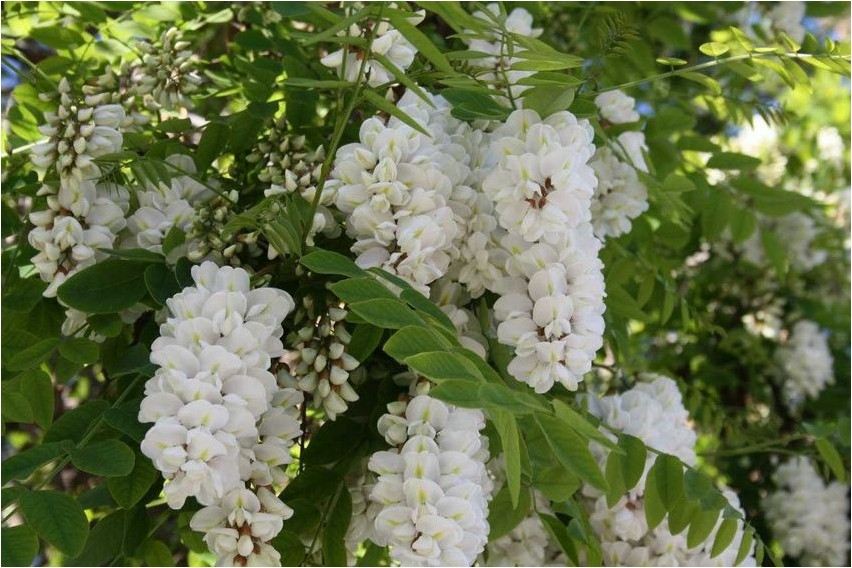
Acacia (lat. Acacia) is a genus of shrubs and trees of the Legume family. Under natural conditions, representatives of the genus are found in Asia, South America, Africa and Australia.
Typical places of growth are dry deserts, rocky areas, lowlands, river valleys, mountainous areas. They are distinguished by rapid growth; by the age of 25-30, growth stops.
Characteristics of culture
Acacia is a shrub or tree up to 25 m high, which during the growth process forms abundant shoots from the root collar and root suckers. Some species are equipped with spines. The bark of young plants is smooth, green, but with age it becomes brown or gray in color and becomes severely cracked. The root system is powerful and highly branched.
The leaves are compound, singly or doubly pinnate, consisting of small leaflets that can be needle-shaped, lanceolate or broadly ovate in shape. The leaf arrangement is alternate or whorled. The leaves are equipped with small leathery stipules; some representatives of the genus lack stipules.
The flowers are numerous, small, collected in capitate, racemose or paniculate inflorescences, located at the ends of branches or in the axils of leaves. Flowers can be bisexual or dioecious. The calyx is fringed-dissected or bell-shaped, sometimes completely absent.
The fruit is an elongated ovoid, linear or lanceolate bean, opening with two valves when ripe, and can be leathery or woody. The seeds are black, brown or light brown, spherical, ellipsoidal or elongated ellipsodial, often flattened.

Growing conditions
Acacia is a light-loving crop, develops well and blooms profusely in open sunny areas with protection from cold winds. Tolerates light shading. Soils are preferably well-drained, light, loose, moderately moist, fertile. Representatives of the genus do not accept compacted, heavy clayey, highly acidic soils.
The crop should not be grown in lowlands, where large amounts of melt water accumulate in the spring. Planting on southern slopes is encouraged. The winter hardiness of different types of acacia varies quite widely. As plants age, their resistance to unfavorable factors increases.
Reproduction
Acacia is propagated by seeds, root suckers, root shoots and cuttings. The seed method, although labor-intensive, is very effective. The seeds need preliminary preparation; for this they are soaked in hot water (50-60C) for 24 hours. Acacia seeds are sown in seedling containers, covered with glass and placed in a warm room. Crops are regularly sprayed with warm, settled water and ventilated.
In the phase of two true leaves, they are planted into separate pots with a diameter of 7-8 cm. As the seedlings grow, they are transferred to larger containers, as well as fertilized with mineral fertilizers. To accelerate the growth of seedlings, you should use phytostimulants, for example, Novosil or Epin. Plants are transplanted into open ground after 1-2 years.
A common method of propagation among gardeners is by cuttings. Acacia is cut from spring or at the end of August. For rooting, cuttings are planted in a light substrate consisting of sand, peat and perlite. The optimal temperature for rooting cuttings is 25C. Rooted cuttings are planted in a permanent place next spring.
Possible difficulties during cultivation and care
All species of the Acacia genus need regular and abundant watering. If there is insufficient moisture, plants often lose buds and leaves wither. Overwatering is also undesirable; it can lead to plant death. Lack of sunlight causes pale foliage and flowers. If tall trees are planted next to acacia, it is necessary to prune thickening shoots that prevent the plants from developing normally.
Acacias are prone to being affected by various diseases and pests; in order to prevent these problems, it is important to comply with all cultivation conditions and carry out preventive treatments with herbal infusions from time to time. If the damage is severe, it is better to use insecticides and other chemicals. Pruning the crop must be done with gloves, as the plants are poisonous.