Mandevilla Sandera
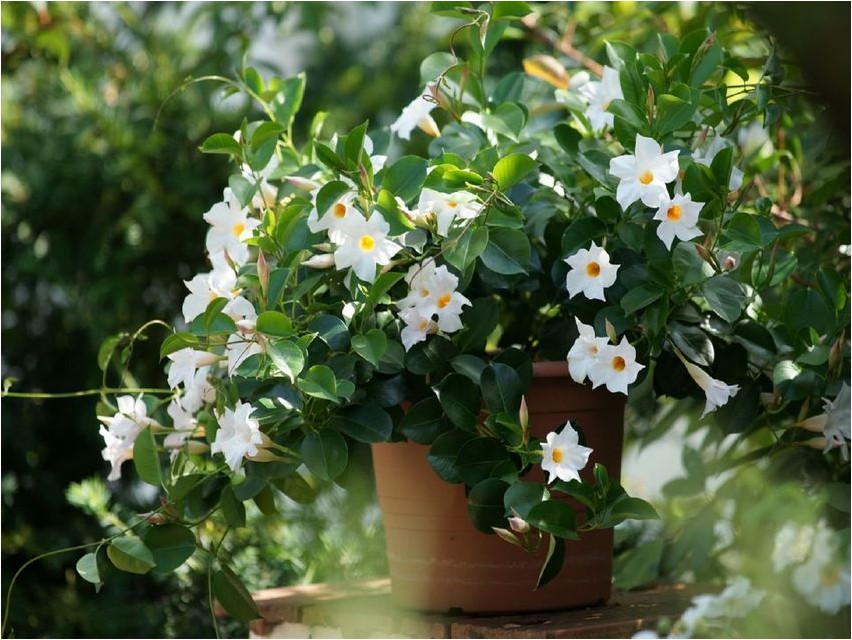
Mandevilla sandera is also known by the name Dipladenia. In Latin, the name of this plant is as follows: Mandevilla sanderi.
Mandevilla sandera is one of the plants of the family called Kutraceae, in Latin the name of this family will be Apocynaceae.
Description of the characteristics of growing mandevilla sandera
The plant will need to provide either a sunny light regime or a partial shade regime. In the summer, it is recommended to provide Mandeville sandera with abundant watering, and air humidity throughout this period should be kept at a fairly high level. The life form of Mandevilla Sandera is an evergreen vine. It is recommended to grow this plant either in winter gardens, or in florariums, or in display windows. Also, quite often the plant is grown indoors.
The maximum size of this plant in cultivation will be approximately three to four meters: this mark refers to the length of the shoots. As for replanting the plant, this procedure is recommended to be performed every few years. It is recommended to choose pots of standard proportions. You will need to prepare the following composition of the soil mixture: for this, take one part of turf soil and one part of sand, as well as two parts of leaf soil. The acidity of the soil should be acidic.
As for possible problems with growing, it is important to remember that if the plant is grown indoors without a greenhouse, the plant will not be able to develop normally. This is explained by the fact that Mandevilla sandera requires fairly high air humidity. Throughout the entire dormant period, the plant will need to ensure the following optimal air temperature: this mark should be kept at thirteen to eighteen degrees Celsius. Watering Mandeville sandera requires moderate watering, and air humidity should remain quite high even during the dormant period. If the plant is grown indoors, the dormant period is forced: this dormant period will last from October to February. The presence of a dormant period is explained by the fact that at this time the air humidity will be low, and the plant will not receive a sufficient degree of illumination.
Mandevilla sandera is propagated by rooting semi-lignified cuttings: when performing this procedure, it will be necessary to ensure high air humidity, and the temperature should not be below twenty-five degrees Celsius. Regarding the specific requirements of the culture, it is important to remember that Mandevilla sandera will require constant maintenance of very high air temperatures, which should be kept at a level of sixty to seventy percent. You should also provide reliable support for climbing shoots. At the same time, the soil of the plant should never dry out, oddly enough, this also applies to the period of winter dormancy. After the end of the dormant period, the shoots of Mandevilla sandera should be cut back by one third or even half the length.

The leaves and flowers of this plant have decorative properties. When it comes to the leaf color of Mandevilla sandera, the leaves will be dark green. The leaves of the plant are smooth and oval, they are endowed with a pointed tip, and the length of these leaves will be about ten centimeters, and the width will reach about four to six centimeters.
Mandevilla sandera blooms in both spring and summer. The color of the flowers will be either pink or crimson. The flowers of the plant are found in few-flowered inflorescences, one or even three.