Tangelo
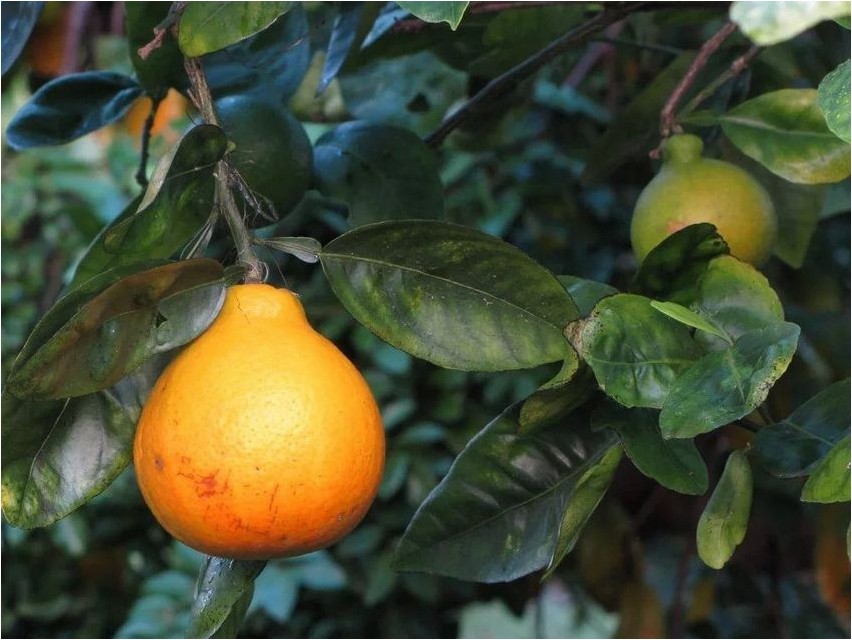
Tangelo (Latin C. reticulata x C. paradisi) is a fruit crop that is a hybrid of the pomelo or grapefruit with the tangerine. This hybrid was developed back in 1867 by the U. S. Department of Agriculture.
Description
Tangelos are fruit trees growing from five to seven meters tall and boasting much better frost resistance than their grapefruit cousins.
The spherical tangelo fruit, with its characteristic bulges near the stalks, is almost never larger than a small grapefruit or orange. The orange peel of these fruits is very similar to the familiar orange peel, but, unlike the latter, it always separates very easily from the pulp. The pulp can be orange or yellow in color. The taste is sweet and sour, very pleasant. Incidentally, these fruits don”t have that many seeds—about the same number as oranges.
Several varieties of this fruit are currently known: Alemoen, Orlando, Mineola, Clementine, Ugli, Thornton, and Simenol.
Where it grows
Tangelos are widely cultivated in Israel, Turkey, Florida, and several other countries with subtropical climates.
Uses
Tangelos are very tasty fresh, with a caloric content of only 36 kcal per 100 g. When purchasing this fruit, it”s important to ensure that the skin is uniform and brightly colored, free of any bloom or blemishes. The skin should be completely free of damage: no dents, cracks, or easily dented areas. The weight of each fruit must be perfectly proportional to its size: fruits that are too light are a clear sign that the flesh has begun to dry out.

Tangelos are best stored in the refrigerator, at a temperature of between two and seven degrees Celsius (30 and 45 degrees Fahrenheit). This way, the fruit will retain its valuable properties for two weeks, remaining juicy and flavorful. If you leave tangelos at room temperature, you”ll notice spoilage within three days.
Tangelo is widely used for preparing various dishes — these fruits are especially often found in recipes of South American and Mediterranean cuisines. Confitures, jams and tangelo preserves will please even the most fastidious gourmets. Often the pulp of these fruits can be found in all kinds of fruit and berry salads. And, by the way, it goes perfectly with fish dishes and seafood. And from the peel they make wonderful candied fruits, which, when dried, are often added to tea.
Vitamin PP contained in tangelo is the key to healthy and strong capillaries and blood vessels, and folic acid in its composition has an extremely beneficial effect on the condition of expectant mothers and babies. Tangelo also boasts a pronounced diuretic and choleretic effect and the ability to increase appetite. It will also be an excellent helper for weak digestion and constipation. These fruits are especially recommended for people leading a sedentary lifestyle and the elderly. Tangelo also contains phosphorus, which is vital for maintaining healthy teeth and bones. And potassium makes these citrus fruits excellent helpers for hypertensive patients.
It is recommended to drink tangelo juice for depression, vitamin deficiencies, for the prevention of various colds, and for pregnant women with toxicosis.
And the oil obtained from the skin of the tangelo has found its application in cosmetology — with its addition, wonderful soaps, scrubs, creams, shampoos, shower gels, etc. are made.
Contraindications
Tangelo should not be used for chronic diseases of the gastrointestinal tract and gastritis accompanied by high acidity. And for diabetics, these fruits are generally categorically contraindicated. Don’t forget that, like all citrus fruits, tangelo can cause allergies.