Buddleya
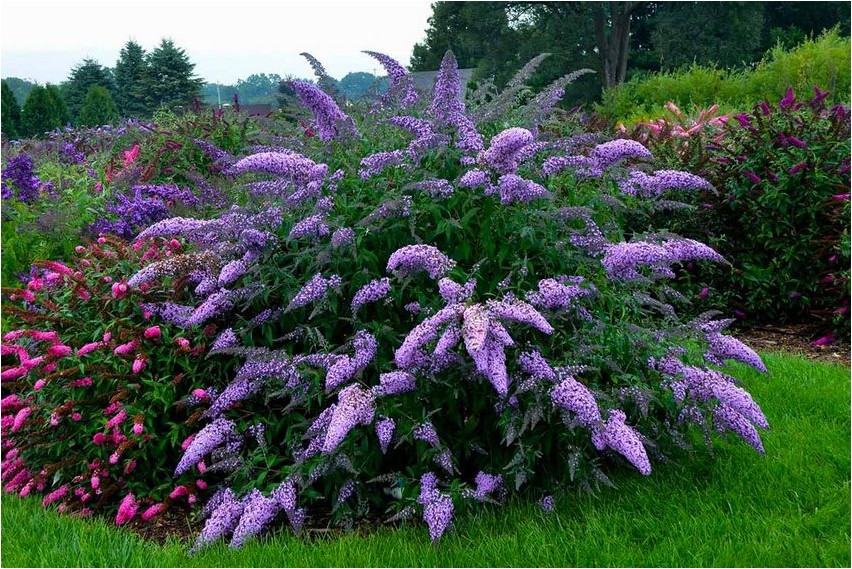
Buddleja (lat. Buddleja) is a genus of herbaceous plants, deciduous or semi-evergreen shrubs of the Norichinaceae family. The early genus was classified as the Buddlevy family.
The genus has about 100 species. Buddleia has a long and interesting history. The plant is particularly decorative; during flowering it emits a pleasant honey aroma that attracts butterflies. For this reason, the crop is often called a “butterfly magnet.” The natural range is tropical, subtropical and temperate latitudes of Asia, America and South Africa.
Characteristics of culture
Buddleia is a spreading deciduous or semi-evergreen shrub up to 5 m high with brownish-green branches that are slightly ribbed and drooping at the ends. The bark is light brown or dark brown, fissured. The leaves are large, dark green, tomentose below, oval-lanceolate in shape. The flowers are small, white, yellow, blue, purple with a bright orange eye in the center, collected in spike-shaped inflorescences that look like lilac inflorescences.
In some species, in particular Buddleia David, the inflorescences reach a length of 40 cm. Buddleia blooms from July to October, the flowering time depends on the species and variety. The seeds are small, numerous, and ripen in September-October. Buddleias are characterized by rapid growth; even frozen shoots are soon restored and bloom in the same year.
Growing conditions
Buddleias are light-loving, grow better and bloom profusely in sunny areas, protected from drafts and cold winds. Soils are preferably well-moistened, drained, nutritious, rich in humus, loose, neutral or slightly acidic. The culture does not accept saline, waterlogged, swampy and highly acidic soils.
The optimal temperature for normal development is 20-25C. Buddleias are not resistant to frost; the most cold-resistant species can withstand temperatures down t o-20C. The culture does not tolerate thickening, otherwise the plants will form flat and one-sided. Subject to the growing conditions and proper care, the plants will delight their owners with lush flowering and a delicate sweetish aroma.

Reproduction and planting
Buddleias are propagated by seeds, green and woody shoots. Sowing is carried out in early spring or before winter. Seeds do not need preliminary stratification. Sow the seeds in seedling boxes filled with moist soil without deep planting, lightly sprinkled with turf soil or humus.
The seedlings are covered with plastic or glass, periodically ventilated and moistened. The seeds germinate in about 3 weeks. When the seedlings develop 2-3 true leaves, they are pricked out into individual pots and planted outdoors in early June. With proper care, young plants grown from seed will bloom in the second year.
Propagation by cuttings is carried out immediately after flowering. Cuttings are taken from young shoots approximately 20 cm long. Each cutting should have at least 3 buds. The cuttings root within 1. 5-2 months. The cuttings can be stored for short periods in a cool, frost-free place. Buddleias grown from cuttings grow to 60-70 cm in size over the course of a season.
Care
Proper care and attention to buddleia will ensure the plant”s health, favorable wintering, decorative appearance, and lush flowering. Formative and sanitary pruning are considered to be one of the most important tasks in buddleia care. If pruned insufficiently, buddleia bushes become elongated, bare, and rarely bloom. Buddleias respond well to watering and mineral fertilizers.
The latter significantly increases the size and number of inflorescences, as well as the intensity of their color. In the fall, mulch the trunk area with peat or humus to prevent dormant buds located at the base of the shoots from freezing. You can wrap the bushes with lutrasil or any other covering material, but it must be removed before the onset of stable warm weather, otherwise the plants will begin to rot. THE MOST UNPRETENTIOUS BUSH IN THE GARDEN IS THE BUDDLEA





