Cortuza
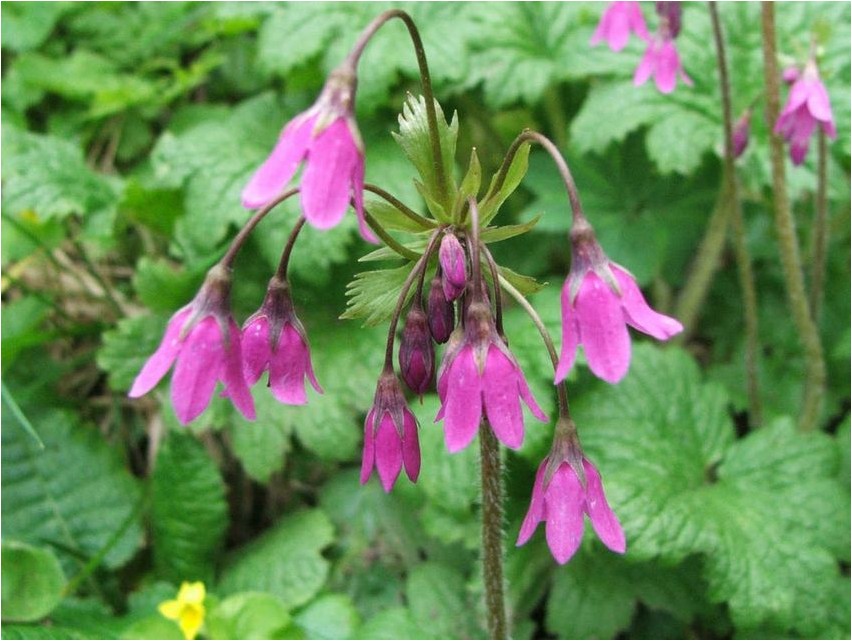
Cortusa (lat. Cortusa) is a small genus belonging to the family Primroses (lat. Primulaceae). It includes only four species, each of which deserves the attention of both gardeners and people choosing alternative medicine.
In nature, representatives of the genus are found in the mountainous regions of European countries, most often in the south and east. Plants can often be photographed in the Alps and China.
Characteristics of culture
Cortuse is represented by perennial herbaceous plants of small height, usually up to 20 cm, although the flower stalks rise much higher. As they grow, they form not too dense clumps bearing light green heart-shaped foliage, equipped with jagged edges, as well as bell-shaped flowers collected in apical umbellate inflorescences. The flowers, in turn, have a delicate pink, white or purple color, and yellow-flowered specimens are also found.
It should be noted that some scientists do not divide the genus into four species, but distinguish only one – Matthioli’s cortus (lat. Cortusa matthioli) or, as it is also called, Zarzhitsa. This species is represented by short-rhizomatous plants that form rosettes of pubescent leaves and rich purple flowers, which, by the way, are formed several times per season. A similar situation exists with fruits. In nature, the species in question is protected, but it can be found in abundance in Russian and European gardens, because it is not only highly decorative, but also has healing properties.
It is impossible not to note one more representative of the genus – Siberian cortuza (otherwise known as Yakut cortuza). This healing plant has gained popularity among people interested in traditional medicine. In nature, it can be found on rocky areas, cliffs and the banks of streams in Siberia and the Far East. Externally, the plant looks inconspicuous, it is characterized by rounded pubescent foliage of a grayish-green color, the finest flower arrows and medium-sized reddish-purple flowers collected in umbrellas. But, despite this, this species is still loved by gardeners and flower growers in the country, because it will decorate shady areas of the garden, where most flower crops do not get along.
Features of cultivation
All representatives of the Cortuz genus belong to the category of unpretentious plants. They accept shady areas with moist soil (in moderation). The culture will not tolerate coexistence with dry, waterlogged, strongly acidic, saline and heavy clay soils. On the latter, cultivation is possible only with good drainage, otherwise the plants will not even survive to flower. The sun is not its friend, but provided regular and abundant watering they get along well, except that the flowers are less bright.

The cortuza does not require special care. Standard procedures are required – watering, weeding, loosening. Cortuse is winter-hardy, but when expecting a harsh snowless winter, you should cover the curtains with a thick layer of fallen leaves. The crop also requires timely replanting and thinning, maintaining an optimal distance between plants of 20-25 cm.
Usage
Cortuza, as already mentioned, can be used both in gardening and in folk medicine. You can plant plants in a rocky garden or along the shady shore of an artificial or natural pond. In medicine, the use is more extensive. Cortus rhizomes and foliage contain a number of useful substances required by the human body to maintain the functioning of many vital organs and systems, as well as to treat certain diseases. Thus, Siberian cortuza is used to eliminate inflammation of the integument and quickly heal open wounds, as a diuretic and choleretic agent, as well as for the treatment of diseases of the upper respiratory tract, including bronchitis.





