Dendrobium noble

Dendrobium noble – translated from Latin, this name means “living on a tree.” Such plants belong to the most numerous genera of the Orchidaceae family.
Experts are of the opinion that there are more than a thousand species of dendrobium. It should be noted that the genus, in turn, is also divided into subgroups, which are called sections. At the same time, each section should be provided with very special care; it is almost impossible to give general recommendations here.
Very often you can find two variants of this plant on sale: moth dendrobium and noble dendrobium. They are quite easy to distinguish from each other: moth denbrobium is a heat-loving orchid that can be purchased literally all year round. The peduncle appears from the very top of the shoot; the peduncle can bear up to twenty large flowers, which have practically no smell.
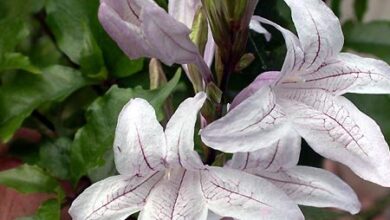
Dendrobium nobilis has a peduncle with one to four flowers. In this case, the flower stalks will cover almost the entire trunk of the plant. The aromas of such flowers are very pleasant.
Dendrobium nobilis first came to Europe from India in the nineteenth century, during which time it was called orchid fever. Already at that time this plant was considered one of the most beautiful. In the modern world, many novice flower growers prefer this particular option for breeding.
When active growth occurs, plants should be provided with maximum heat and light. It will be great if you can place the orchid in the garden or on an open balcony during this period: in this case, the plant will receive the required amount of direct rays of the sun.

During the period from spring to August, the plant will need very abundant watering, but this should be done only after the soil in the pot is completely dry. Regular feeding is also recommended.
After August, watering should be slightly reduced, and the plant will no longer need fertilizer. At this time, the pot with the plant should be placed in a place where the sun shines in full force. In winter, you should water the plant very carefully and do this quite rarely.
Transplant
It is recommended to transplant the plant in the spring. The soil should also not be compacted, but voids between the roots should also not be allowed. The first watering should be done after about a week or even ten days. It is worth noting that the plant should be replanted every two to three years.
Feeding dendrobium
When the plant is actively growing, it needs fertilizing, which is very important for dendrobium. For those plants that require cold winters, fertilizers with a reduced nitrogen content are suitable.
Many experts recommend the following fertilizing system: when the plant is just beginning to grow, it is given nitrogen fertilizers, where this element is found in large quantities. Next, use only special fertilizers or those that do not contain any part of nitrogen.
Dendrobium propagation
The first way to propagate this plant is to divide a large bush. This will involve untangling the root ball and then cutting it. Moreover, each part of the so-called division must contain at least two mature bulbs and a pair of young ones. Dividing in this way should be done immediately after flowering.
Another way would be to separate a young plant from an adult. Experts advise first observing the plant for about a year, and only next spring the baby is separated from the mother plant using a sharp scalpel, and you will also need to grab a piece of the mother’s bulb. In this case, flowering will begin within a year. Whatever method you choose, the main thing is to strictly follow all the instructions and then the result will never disappoint you.