Bloody Geranium
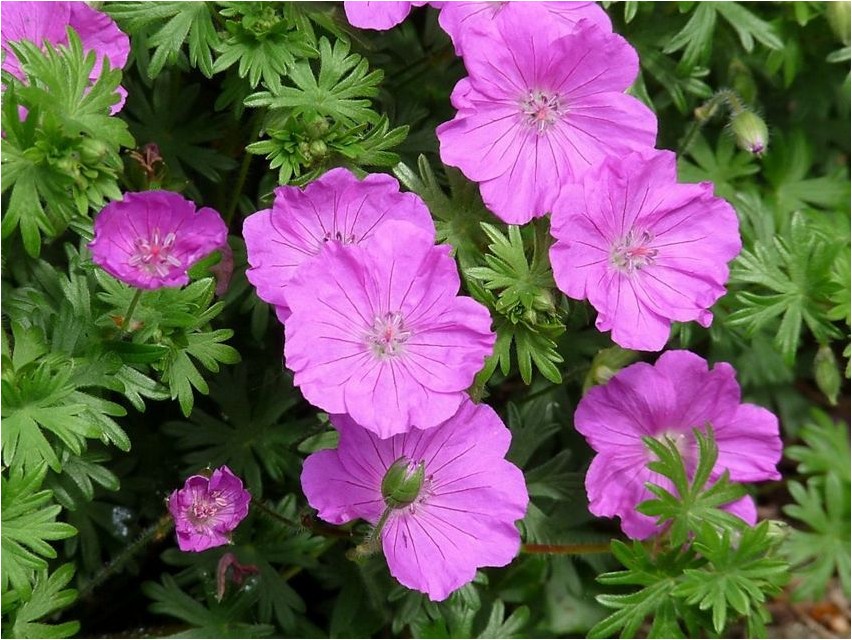
Bloody Geranium is a member of the Geraniaceae family, and its Latin name is Geranium sanguineum L.
The family name of Bloody Geranium is Geraniaceae Juss.
Description of Bloody Geranium
Bloody Geranium is a perennial herbaceous plant with a knobby rhizome and forked stems. The stems of this plant are covered with fairly long, drooping hairs. The bases of the stems and the lower leaves of Bloody Geranium turn red in autumn. The leaves themselves are borne on fairly long petioles, and the leaf blades are either rounded or kidney-shaped, and can also be deeply palmately divided. The leaf blade of the bloody geranium has five to seven lobes, which are divided into three to five oblong or linear lobes. These lobes are covered with long white hairs underneath. The flower stalks of this plant are also quite long, most often single-flowered. The petals of this plant are crimson-red, twice as long as the sepals, and approximately fifteen to twenty millimeters long. Bloody geranium blooms in summer. In the wild, this plant can be found in the Caucasus, as well as in the European part of Russia, where bloody geranium is most common in the western regions. This plant prefers shrubs, dry slopes, and forest edges.
Description of the medicinal properties of bloody geranium
For medicinal purposes, it is recommended to use the flowers, roots, and herb of this plant. The herb includes the flowers, leaves, and stems. It is recommended to harvest the herbs and flowers of the blood-red geranium around June-August, while the roots should be harvested in September-October.
The entire plant contains a significant amount of tannins, as well as vitamin C, resinous, bitter, and mucilaginous substances, and other compounds. Preparations based on this plant have analgesic, astringent, antiseptic, anti-inflammatory, and hemostatic properties. Furthermore, such preparations can dissolve salt deposits associated with gout and kidney stones.
An infusion made from the herb of this plant should be used for diarrhea in both children and adults, as well as for rheumatism, gout, and kidney stones. This remedy is also effective for pulmonary, uterine, and nasal bleeding, for inflammation of the oral mucosa, and even for treating various skin conditions.

In folk medicine, an infusion of the rhizomes of blood-red geranium is used for internal bleeding, for washing festering wounds and for gargling bleeding gums. It also serves as a pain reliever for sore throats and as an anti-inflammatory.
It is noteworthy that the rhizomes of this plant have anti-inflammatory and astringent properties, which is used to treat tuberculosis, bronchitis, gastrointestinal diseases, and dysentery. An infusion of blood-red geranium is effective for washes and compresses on abscesses, ulcers, skin conditions, and festering cuts. A decoction made from blood-red geranium is used for bone fractures, as a gargle for sore throats, and even as a hair wash for hair loss.





