Agapethes
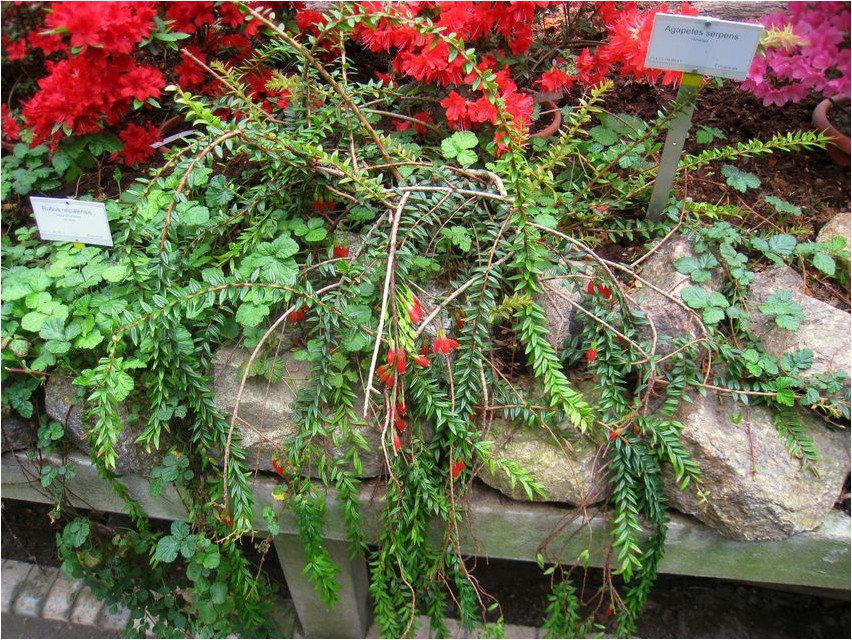
Agapetes (lat. Agapetes) are evergreen shrubs belonging to the Heather family. Agapetes was first described by D. Don in 1881.
Description
Agapethes is an evergreen shrub (occasionally it can have the appearance of a creeping vine), reaching a height of half a meter to a meter and endowed with a noticeably thickened trunk near its base. And the small, dense-skinned leaves of this plant are usually whorled or alternate and boast a pronounced oblong-ovate shape.
Agapethes flowers can be either single or collected in luxurious umbrellas or brushes. As for their color, red, pink, and white flowers with a pinkish tint are equally common. In total, the Agapethes genus has from eighty to ninety-five different varieties.
Where does it grow
The Eastern Himalayas and Western China are considered to be the homeland of Agapethes. In general, this plant is quite widespread throughout the entire territory, from the Himalayas to Northern Australia.
Usage
Agapethes is a favorite indoor plant, widely used to decorate various rooms and to create magnificent indoor arrangements. It can be seen especially often in greenhouses or cool rooms. And in Nepal, agapetes leaves are often brewed as tea.
Growing and care
Agapethes will feel great on eastern or western windows. Since he is very light-loving, it is important to try to provide him with bright, diffused lighting. In summer, this plant is usually kept at a temperature of eighteen to twenty-five degrees, and in winter – from twelve to fifteen degrees.

It is advisable to take pots for placing agapetes that are wide and low, and as for soils, to grow this beauty, it is ideally recommended to turn your attention to heather soils, which are characterized by an acidic reaction. The soil should be permeable and fairly loose (rotted pine needles, leaf soil, humus and moss taken in a ratio of 2:2:1:4 can be used as a substrate). In addition, it is important to provide agapetes and good drainage.
In summer, agapetes is watered quite abundantly, but winter watering should be quite meager. In addition, once it enters the active growth and flowering stage, it will need regular spraying. And during this period, approximately once every two or three weeks, the plant needs to be fed with high-quality mineral fertilizers. In winter, Agapethes does not need any feeding.
This green pet is usually replanted in the spring, doing this as needed. And the formation of bushes is carried out in early spring: for this purpose, the tips of the plant are slightly trimmed, and, of course, the agapetes are also pinched.
This beautiful plant is propagated by semi-lignified shoots, that is, cuttings, but the first flowering of rooted cuttings can only be admired after two to three years. As for seed propagation, it is usually not used at all under indoor conditions. If, nevertheless, it was decided to propagate agapetes in this way, then the seeds are sown in a well-permeable and fairly loose substrate, doing this exclusively in the spring. Then the containers with tiny seedlings are placed in a fairly warm place, the temperature in which should not fall below twenty-one degrees, after which they are covered with film, regularly ventilated and periodically watered. And as soon as the third leaf appears on the plants, pick them immediately.
Agapethes is very resistant to various ailments and all kinds of pests, but occasionally it can still be attacked by spider mites.