Eleutherococcus
Eleutherococcus (Latin: Eleutherococcus s) is a hardy woody plant from the Araliaceae family.
Other names include free-berry, Siberian ginseng, prickly or wild pepper, and also devil”s bush or netron (the last two names eleutherococcus received because of its prickly and unattractive appearance among all the plants belonging to the Araliaceae family).
Description
Eleutherococcus is a prickly, medium-sized shrub with numerous palmately compound leaves. Its height typically ranges from one to two meters, but individual specimens can easily reach four to five meters. Each shrub has a huge number of separate stems—there can be twenty-five or even more!
The erect shoots of eleutherococcus are covered with strong, attractive, light-gray bark. They are densely covered with numerous thin, downward-facing spines. The cylindrical, highly branched rhizomes of Eleutherococcus, equipped with a huge number of adventitious rootlets, are usually located in the upper soil layers. The root system of this plant often reaches thirty meters in length!
The palmately compound, obovate leaves of Eleutherococcus sit on long petioles. They are either small-bristled or bare on top, and a slight reddish pubescence runs along the veins underneath. The margins of these leaves are always acutely doubly serrated.
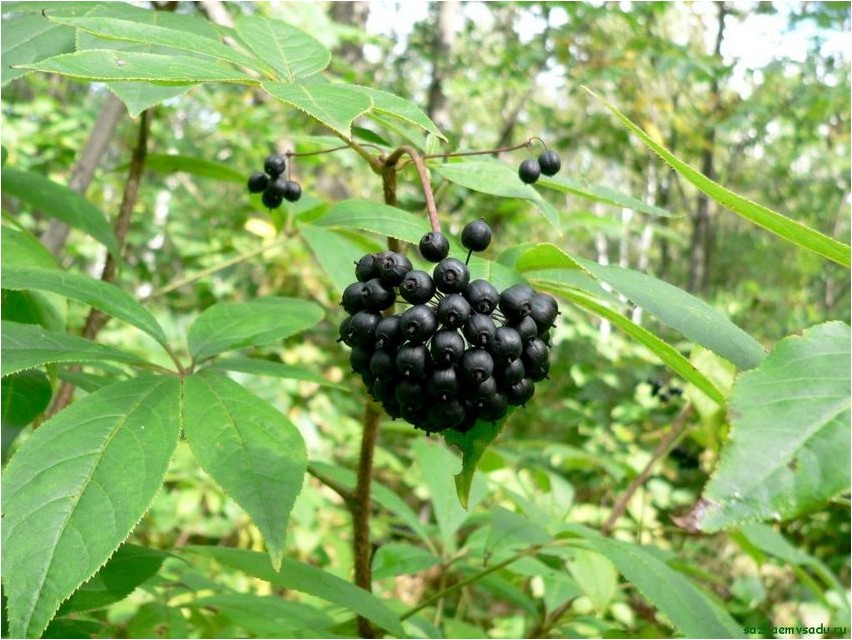
The small, bisexual flowers of Eleutherococcus are gathered at the tips of the branches in simple umbels. The staminate flowers are typically pale purple, while the pistillate flowers are slightly yellowish. Eleutherococcus fruits, which appear as shiny, black, spherical drupes, form fairly large black balls. Each drupe is seven to ten millimeters in diameter, containing exactly five seeds. The yellowish seeds of this plant are characteristically crescent-shaped. All seeds have a finely cellular surface, and their length ranges from 3. 5 to 8. 5 millimeters.

Eleutherococcus typically blooms in July and August, and begins to bear fruit as early as September.
The genus Eleutherococcus includes approximately thirty species of thorny trees and shrubs.
Where it grows
Eleutherococcus is most commonly found in China, Japan, as well as in southeastern Siberia and East Asia.
Uses
There is only one type of eleutherococcus grown in culture: Eleutherococcus senticosus (also called armed eleutherococcus).
It is generally accepted that the medicinal properties of this unique plant are almost identical to the medicinal properties of ginseng, which is why it is often called Siberian ginseng. As a rule, mainly the rhizomes and roots of this plant are used for medicinal purposes. And it is best to dig out adult specimens for this purpose, the height of which exceeds the meter mark.
Eleutherococcus is excellent for coping with fatigue (both physical and mental) and low blood pressure, in addition, it is an excellent tonic. However, it is strictly not recommended for use in cases of hypertension, as well as acute infectious diseases and sleep disorders.
Growing and care
Eleutherococcus will feel best in light shade (it is very shade-tolerant and shade-loving), on well-moistened and fairly fertile garden soils. If the summer turns out to be dry, the plant must be watered regularly. And in winters with little snow, Eleutherococcus will need good shelter.
Eleutherococcus is propagated by root suckers, dividing bushes, seeds (with mandatory preliminary stratification), as well as layering or green cuttings.
As for various pests and diseases, Eleutherococcus is practically not susceptible to their attacks.
Eleutherococcus: Effects, Insulin, Adaptation