Vallota

Wallota belongs to the family called amaryllidaceae. The humid subtropics of South Africa are considered the birthplace of this plant. As for the degree of ease of cultivation, even a novice gardener can cope with this.
The genus itself owes its name to a French botanist; there is only one species in this genus, which grows in South Africa.
In cultivation, there are several plants, one form of which is endowed with white flowers, and the other with large ones, which reach twelve centimeters in diameter. This plant has been grown indoors since the seventeenth century.
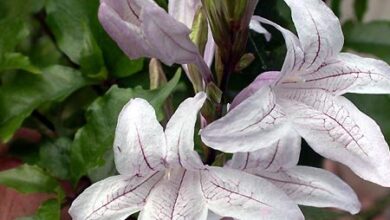
This plant is a bulbous perennial, in which the bulb itself is ovoid and small in size. This bulb protrudes halfway above the ground and has filmy outer scales. The plant bulb is capable of producing many children. The leaves of the plant themselves are leathery, dark green in color, and also shiny. At the base, the color of the leaves turns reddish; the shape of the leaves is belt-shaped, xiphoid or linear. The leaves can reach sixty centimeters in length and three centimeters in width. The flowers of the plant are symmetrical, each of them has six petals, which are collected in inflorescences of three to nine pieces, and the height of the peduncle is about forty centimeters. At the base of the inflorescence there are two rather large scales. The perianth of the plant will be funnel-shaped or bell-shaped, it will be eight centimeters in length, and the diameter can even reach ten centimeters. The perianth is colored white, pink or bright red.
One flower will bloom for about five days, with several flowers blooming at the same time. Under proper growing conditions, the plant will flower twice a year: the wallflower will bloom for the first time in the spring, around May-June, and secondary flowering will begin in the fall, in September-October.
Caring for and growing wallot

Actually, wallot is quite unpretentious in care. The plant grows well in rooms with a sufficient degree of illumination, especially on window sills. However, this plant can grow in partial shade. This will require reliable protection from intense direct sunlight.
As for watering, during active growth and flowering of the plant, very abundant watering will be required. In addition, at this time it is also necessary to fertilize with mineral and organic fertilizers, which will stimulate more abundant flowering of the plant. However, in the period from October to December, watering should be significantly reduced, and fertilizing the plant is contraindicated. If temperatures are very cold in winter, the plant should be watered extremely rarely.
The air humidity for wallot should be moderate, and the leaves of the plant should be wiped with a damp cloth from time to time. In winter, it is recommended to put the plant to rest, which will require drying the wallot bulbs.
Actually, thanks to indoor growing conditions, this plant will bloom twice a year, and a sufficient number of bulbs will also form. As for the temperature regime, room temperature should be provided in summer, but in winter the plant will require a temperature regime of about thirteen degrees.
Reproduction of this plant occurs through daughter bulbs, which should be separated from the mother plant. It is recommended to do this in the spring or early summer. However, sometimes wallot can be propagated through seeds. When young plants are planted, the bulbs should rise one third above the ground level. Only one bulb at a time or several very small ones should be planted in a pot.