Lagenaria
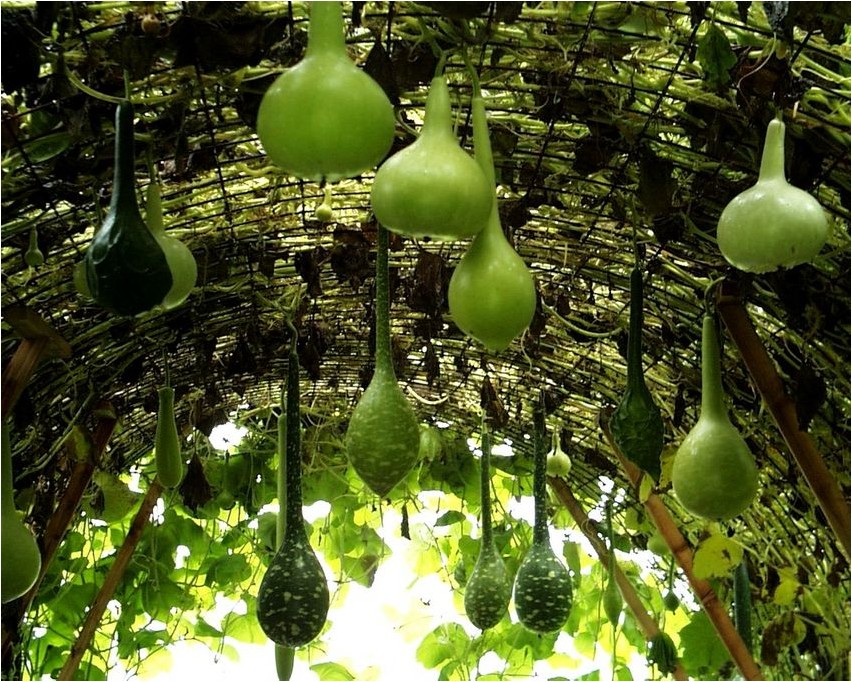
Lagenaria (lat. Lagenaria) — vegetable crop; annual plant of the Cucurbitaceae family. The plant is often called bottle gourd, Indian cucumber, gourd or pot gourd.
The genus includes seven species of herbaceous vines, which are more common in tropical areas of the world. The plant is native to India.
Interesting facts
From the oldest manuscripts of China it is known that for a long time lagenaria was considered the queen of plants; it was grown in the gardens of Chinese emperors, but not for cooking, but for creating durable vessels that were used at dinner parties for particularly distinguished dignitaries. The walls of the fruit are very dense and strong, they are not exposed to microorganisms, and do not decompose, unlike other plants of the Pumpkin family.
Lagenaria was extremely popular among African peoples. The vegetable was used to make dishes, snuff boxes, jewelry, ladles, and even the famous African tom-toms. Surprisingly, the Lagenaria fruit was also used as a monkey trap. A small hole was cut in the fruit, rice was poured inside and tied in a visible place. The monkeys, in search of food, stuck their hand into the hole, collected the rice, squeezed it into their fist, but could no longer pull it out.
Characteristics of culture

Lagenaria is a plant with a creeping, pubescent stem with pronounced edges up to 15 m long. The leaves of the plant are pentagonal and corrugated. The flowers are quite small, dioecious (male and female), white in color, have a wheel-shaped corolla, and are located in the axils of the leaves. Flowers open only at night. Large flowers have an unpleasant odor. The fruit is a pumpkin and can be elongated, round, pear-shaped or bottle-shaped.
Lagenaria is characterized by rapid growth, the growth rate per day is 15-25 cm. There are cases where the fruits of legenaria, under favorable growth conditions and proper care, reached 2 m, sometimes even 2. 5 m. The plant is highly decorative, looks great on any garden plot as a decoration. In Russia these days, a variety of lagenaria — Vietnamese zucchini — is widespread.
Growing conditions
Sites for growing lagenaria are preferably well-lit; southwestern and southern slopes are optimal. Soils are desirable fertile, loose, neutral with a high content of organic matter. Acidic and waterlogged soils are not suitable.
Lagenaria is a climbing plant; it can be planted along fences, walls of houses or near gazebos. The favorable temperature for normal growth and development is 25-27C. The crop is not cold-resistant; it cannot tolerate even the mildest frosts and dies. The best predecessors of lagenaria are legumes, potatoes and cabbage.
Reproduction, seed collection and planting
Lagenaria is propagated only by seed. To collect seeds, use the first set fruit, which is removed along with the stalk and left for storage in a warm room until the end of October — beginning of November. Then the fruits containing seeds are cut with a hacksaw, the seeds are selected and placed in paper bags.
Seeds must be germinated before sowing, because without pre-treatment they will not be able to hatch, since they have a fairly hard crust. The seeds are soaked in water for a day, and then placed in damp sawdust for 7-10 days.
In the southern regions, the crop is grown by sowing seeds in open ground, and in the northern regions — only by seedlings. To grow seedlings, special pots are used in which the seeds are sown. Sowing time is the second or third ten days of April. The seeding depth is 3 cm. The first shoots appear in 1-2 weeks. Seedlings are planted in open ground at the end of May — beginning of June according to the 100*100 cm pattern. The soil temperature at the time of planting the seedlings should be at least 12C.
Before planting, the hole is spilled generously with water, the seedling is lowered into it, sprinkled with soil, watered again and shaded with improvised means for several days. To prevent moisture from evaporating for as long as possible, the soil near the stem zone is mulched with peat or humus. On cool nights, the plants are covered with a special protective material.
Care
In addition to standard procedures, caring for lagenaria includes pinching the central stem and side shoots when they reach 2 meters. Weak shoots and ovaries are completely removed. This technique promotes the formation of larger fruits. During flowering, plants need additional pollination from female flowers.
When fertilizing, which is also necessary for the crop, organic fertilizers alternate with mineral ones. Lagenaria is watered daily, with the exception of rain. The crop requires a garter to support it, but if this is not possible, boards or stones are placed under the plants, which can protect them from the invasion of slugs and the development of rot.