Euphorbia semi-hairy
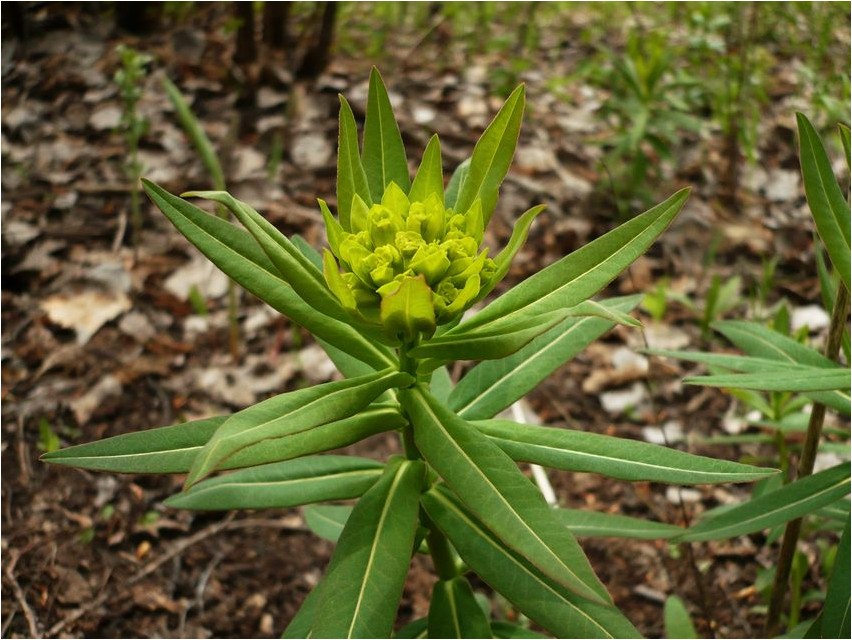
Euphorbia semi-hairy is one of the plants of the family called Euphorbiaceae; in Latin the name of this plant will be as follows: Euphorbia semivillosa Prokh.
As for the name of the semi-shaggy milkweed family itself, in Latin it will be: Euphorbiaceae Juss.
Description of semi-hairy milkweed
Euphorbia semi-hairy is a perennial herbaceous plant, the height of which will fluctuate between thirty-five and two hundred centimeters. The root of this plant is cylindrical; at the very base, under the stem, such a root will be thickened. Most often, this plant has several stems, they are erect and bare, at the bottom their thickness will be about three to seven millimeters, at the top these stems will be ribbed, they are branched and endowed with about one to eleven axillary peduncles. The length of the stems of semi-hairy milkweed will be about two to twenty centimeters, the stem leaves of this plant are linear-lanceolate, their length is three and a half to eleven centimeters, and their width is about six to twenty centimeters. There are only three to eight apical peduncles, their length is one to six centimeters, like the axillary peduncles they will be endowed with two to four secondary peduncles located at the end. A glass of semi-hairy milkweed will be bare on the outside, but shaggy on the inside, its length is two and a half to three millimeters, and its diameter is two and a half to three and a half millimeters. The tricorn of this plant is flattened-spherical, its width is about three and a half to four and a half millimeters, while the length will be equal to three to four millimeters. The seed of the semi-hairy milkweed is smooth and ovoid, it is colored brown, and its length is about two and a half to three millimeters.
This plant blooms from May to July, while the fruits ripen in July-August. Under natural conditions, semi-shaggy euphorbia is found in the European part of Russia, Western Siberia, Crimea and southern Ukraine. For growth, this plant prefers water meadows, salt licks, groves, groves, forest edges, lawns, ravines, steppes, places among bushes, clay and rocky slopes. It is noteworthy that semi-hairy milkweed is a poisonous plant, for this reason, careful care must be taken when handling this plant.
Description of the medicinal properties of semi-hairy milkweed
Euphorbia semi-hairy is endowed with very valuable healing properties, and for medicinal purposes it is recommended to use the milky juice and grass of this plant. The concept of grass includes leaves, stems and flowers. The presence of such valuable healing properties should be explained by the content of fatty oil, quercetin, alkaloids, isoquercitrin, hyperin, isomyricitrin, phenolcarboxylic acids and its derivative gallic acid methyl ester in this plant. It should be noted that hyperin was discovered in the composition of the milkweed grass.
As for traditional medicine, here this plant is quite widespread. Euphorbia semi-hairy in the form of an aqueous infusion prepared on the basis of the herb is recommended for use as a very effective emetic, diuretic and anthelmintic, and is also used for dyspepsia. A decoction prepared from the herb of this plant turns out to be very effective for various skin diseases in the form of baths. The milky juice of milkweed is used externally to remove calluses, warts and age spots. In addition, you should remember that the milky juice of this plant will cause skin irritation.





