Lance-shaped immature
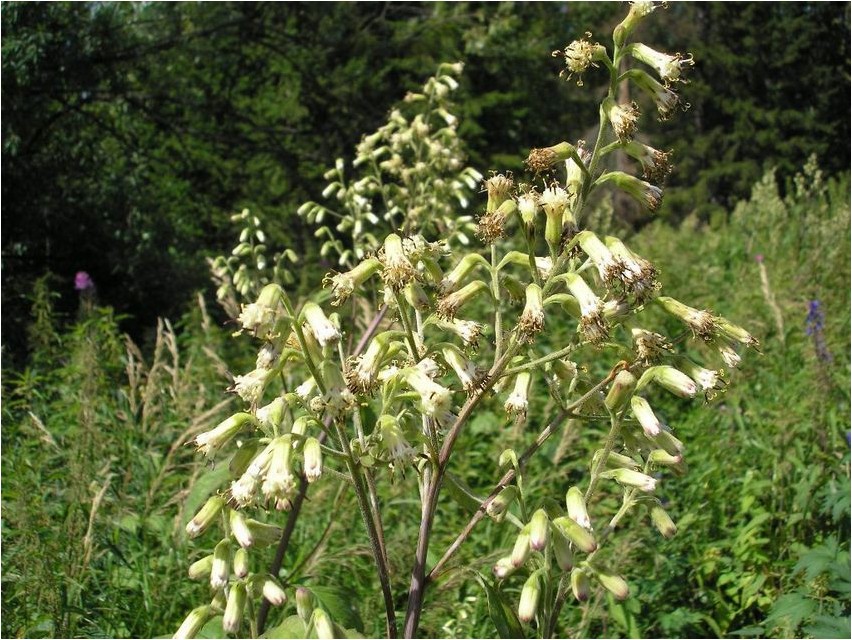
The immature spear-shaped plant is one of the plants of the family called Asteraceae or Asteraceae; in Latin the name of this plant will be as follows: Casalia hastata L.
As for the name of the spearhead family itself, in Latin it will be like this: Asteraceae Dumort. (Compositae Giseke).
Description of the immature lance-shaped
The underripe lance-shaped or spear-shaped cacalia is known by the popular name of crow’s foot and bottomless pipe. The immature spear-shaped plant is a perennial herbaceous plant endowed with a horizontal rhizome. The stem of this plant is straight, most often it will be simple, and its height will fluctuate between forty and one hundred and fifty centimeters. The upper leaves of the immature lance-shaped will be rhombic, the middle leaves are short-petiolate, toothed and triangular-lance-shaped, and at the base they are wedge-shaped. The length and width of the upper leaves of this plant will be about eight to twenty centimeters, the lower leaves of this plant will be kidney-shaped and broadly triangular, they are endowed with a spear-shaped base. The baskets of this plant will be tubular and painted in whitish-cream tones; such baskets of bisexual flowers will form a narrow paniculate inflorescence, which is located at the very top of the stem. The involucre of the baskets of the unripe spear-shaped will be tubular and consist of eight to ten leaves. The seeds of this plant are endowed with long shoots.
This plant blooms from July to August, while the seeds ripen from August to September. In addition, the unripe spear-shaped plant is also a honey plant. For growth, this plant prefers the Far East, Siberia and the northeast of the European part of Russia. For growth, this plant prefers the bottoms of ravines, clearings, forest edges, tall-grass subalpine meadows, river banks, thickets of bushes, small-leaved and sparse forests.
Description of the medicinal properties of the under-ripe spear-shaped
The immature lance-shaped plant is endowed with very valuable healing properties, and for medicinal purposes it is recommended to use the leaves, rhizomes and roots of this plant. The leaves of this plant should be harvested from July to August, while the rhizomes and roots should be harvested from September to October.
The presence of such valuable healing properties should be explained by the content of carotene, ascorbic acid, alkaloids and tannins of the pyrocatechol group in the composition of the under-ripe spear-shaped fruit. The roots and rhizomes of this plant contain the following trace elements: boron, zinc, iron, copper, barium, magnesium, lead, nickel, titanium, strontium, vanadium, nickel, inumin.

Research has proven that the leaves of this plant have a wound-healing effect, especially for infected wounds. Most likely, this is due to the high carotene content in the leaves of this plant. In addition, it was experimentally proven that the plant will also have an antispasmodic effect, while the drug based on the underripe lancet will have a laxative effect.
As for traditional medicine, here this plant is quite widespread. Here, fresh and dried leaves, rhizomes and roots of the unripe lance-shaped plant are used. Fresh leaves of this plant help with trophic ulcers, purulent wounds, calluses, abscesses and boils. It is noteworthy that the infusion and decoction prepared from the herb of this plant are strong laxatives.





