Peanut
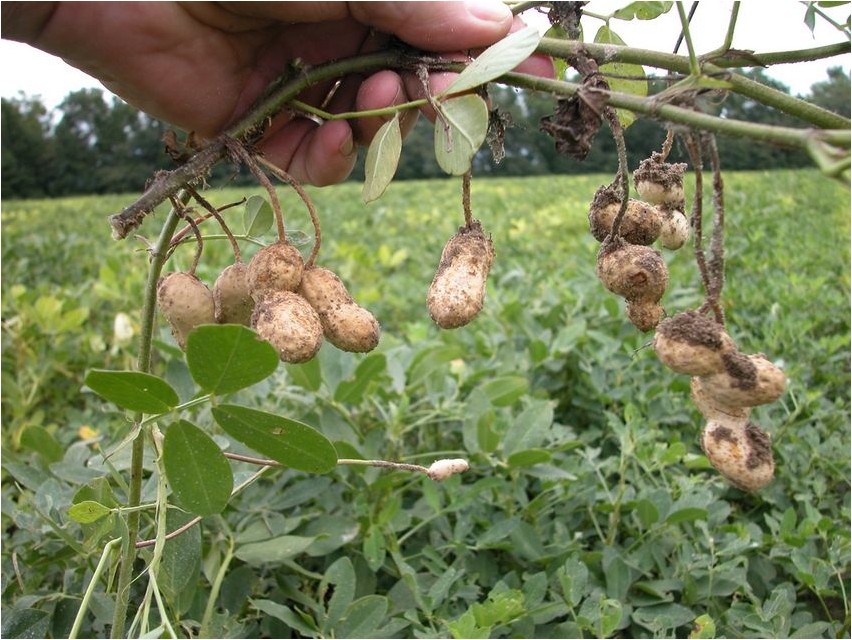
Peanut (lat. Arachis) is a genus of herbaceous plants of the Legume family. The most common representative of the genus is the cultivated peanut, or groundnut.
Currently, this species is cultivated in many tropical countries, as well as in Europe. The genus includes about 70 species, most of them growing wild.
Characteristics of culture
Peanut is an annual plant up to 70-100 cm high with a taproot, highly branched root system and erect, four- or five-sided shoots directed upward. Creeping forms also exist. The leaves are pinnate, pubescent, petiolate, alternate, up to 11 cm long, equipped with large elongated stipules. The leaves are elliptical, pointed.
The flowers are white or yellow-red, collected in short, few-flowered racemes. The calyx is two-lipped, with a thin tube. The corolla is curved, five-petalled, moth-type. The fruits are formed in place of the flowers located at the bottom of the stems. The upper flowers are sterile. Peanuts bloom from June to October — early November. Peanut fruits are elongated, curved, swollen, with a cobweb pattern, and contain from 1 to 5 seeds. The seeds are round, oval or oblong, up to 20 mm, and can be light pink or dark red in color. The fruits ripen in September — October.
Subtleties of cultivation
Peanuts are a heat-loving crop, so their cultivation in open ground is possible only in regions with a warm climate. Cultivation of peanuts as an indoor crop is not prohibited, but the soil in containers must be well-drained, loose and fertile. Lighting should preferably be intense, without direct sunlight.
There is nothing complicated in cultivating peanuts; the plants need regular weeding, hilling, loosening, fertilizing and moderate watering. Since peanuts have a rather long growing season, in the southern regions of Russia they are grown by seedlings, in which case the fruits have time to ripen before the onset of persistent cold weather. Seedlings are grown in special peat-humus pots filled with soil, sand and humus, taken in equal proportions

When growing peanuts without seedlings, the seeds are sown in holes (three seeds per hole) to a depth of 4-5 cm. The optimal distance between plants in a row is 25-30 cm. Immediately after sowing, abundant watering is carried out. In the future, the crop is watered no more than 1-2 times a week. Overmoistening will have a detrimental effect on the development of the crop, as will overdrying the earthen coma. The first hilling is carried out after the peanut ovaries lie on the soil surface, that is, 7-10 days after flowering. At the same time, complex mineral fertilizer is applied to the soil. Harvesting begins at the moment when the leaves of the plants turn yellow.