Rum Berry
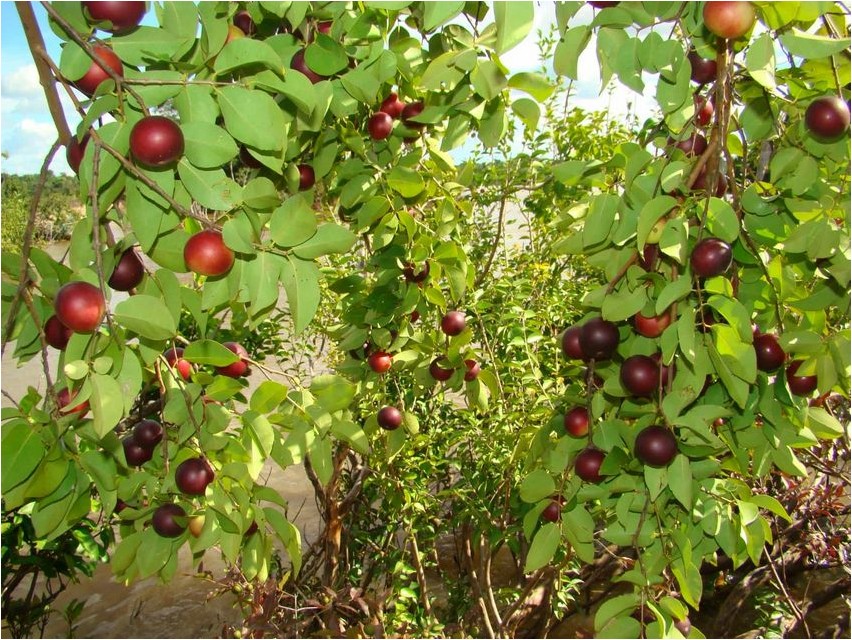
The rum berry (Latin: Myrciaria floribunda) is a fruit tree belonging to the Myrtle family.
Description
The rum berry is a small fruit tree growing from six to ten to fifteen meters in height, with rather colorful branches in reddish-brown hues.
The leaves of the rum berry can be either elliptical or oblong. They typically grow from 2. 5 to 8 cm in length and from 0. 8 to 3 cm in width.
The spherical fruits of the rum berry range in diameter from eight to sixteen millimeters. Each fruit contains a single spherical seed, and the rum berry”s color can range from yellow-orange to dark red (almost black). Furthermore, all fruits have a distinct balsam-like aroma. Where it grows
Both wild and cultivated, the rum berry can be found in Guadeloupe, as well as the Virgin Islands, Trinidad, Martinique, Puerto Rico, Haiti, Jamaica, and Cuba. It also grows quite successfully in eastern Brazil, French Guiana, Suriname, and Guyana, as well as from northern Colombia to southern Mexico. Rum berries are also grown in relatively small quantities in Bermuda, Hawaii, and the Philippines. In the wild, this plant is found primarily on hills and rocky mountain slopes.
Uses
Rum berries can be eaten fresh or used to make alcoholic beverages (including rum), juices, and jams. Rum berries can also be dried and used to make a delicious jam. Rum berries are very rich in vitamin C, essential acids (particularly leucine and serine), as well as organic acids, pectin, and flavonoids.
These fruits are considered an excellent source of iron, so rum berries are recommended for those with anemia. They also significantly strengthen the immune system and stimulate the production of digestive juices, although regular consumption is recommended for this purpose. Due to their high fiber content, rum berries help normalize intestinal microflora, stimulate peristalsis, and even relieve constipation.

Contraindications
Under no circumstances should you overindulge in rum berries if you have high stomach acidity or a peptic ulcer. It is also not recommended for those with an individual intolerance, as these nutritious berries contain substances that can cause allergies.
Cultivation and Care
Rum berry is so unpretentious and unpretentious that it can easily be grown even at home (in this case, the crown is often formed either in the form of a standard tree, pruning its tops and branches, or in the form of a bonsai — rum berry lends itself perfectly to pruning). She will feel especially good on the loggia or in the winter garden. And in fairly warm regions, it is not forbidden to plant rum berries in open ground.
This crop is absolutely undemanding in terms of soil composition, but it will grow best in well-drained and light-composition soil. The only mandatory requirement is low acidity of the substrate. The most preferable areas for planting rum berries will be sunny areas, however, if there are none, do not be upset — they grow very well in partial shade.
As for care, rum berries need to be provided with moderate regular watering and excellent lighting. And this crop overwinters at a temperature of ten to twelve degrees (in a state of incomplete dormancy).
RUM BABA or ROM-BABA! SHE IS AMAZING!!!
Rum berry