Meadow geranium
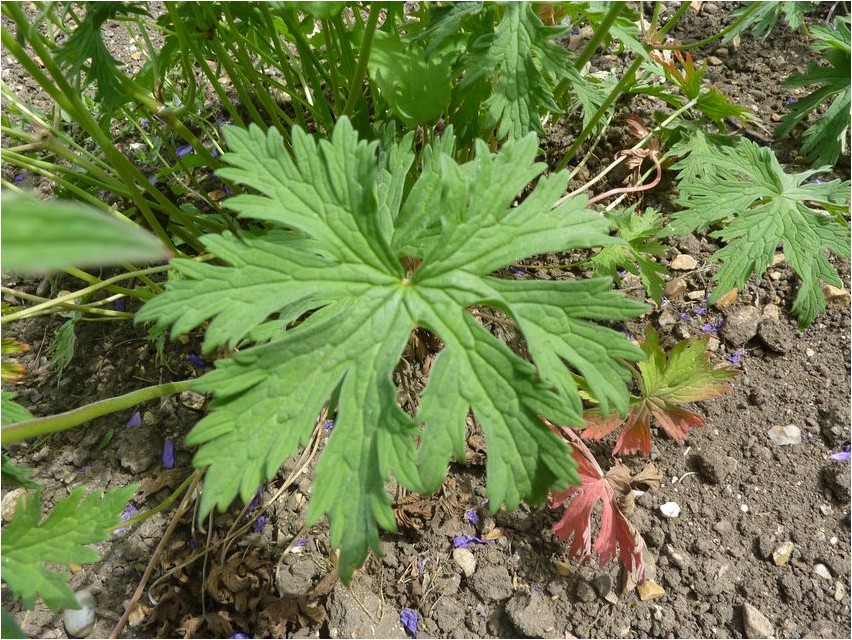
Meadow geranium is one of the plants of the family called Geraniaceae; in Latin the name of this plant will be as follows: Geranium pratense L.
As for the name of the meadow geranium family itself, in Latin it will be: Geraniaceae Juss.
Description of meadow geranium
Meadow geranium is a perennial herbaceous plant. The rhizome of this plant is short, it is endowed with one or several shoots, which are endowed with strong stems that often branch at the top. The basal leaves of this plant are long-petiolate, they are endowed with kidney-shaped-rounded plates, the length of which is about six to twelve centimeters.
The stem leaves of meadow geranium are endowed with shorter petioles, which will be smaller in size and will also be five-partite, while the uppermost ones are three-partite and almost sessile. The flowers of this plant will be quite numerous; they are in an umbrella-shaped inflorescence and are located two on each peduncle. The flowers of meadow geranium will be quite large, regular, and also wide open; before and after flowering, such flowers will droop. During flowering, the open part is directed upward. The perianth of this plant will be double, it is five-membered and free-leaved. The petals of this plant are colored in lilac-blue tones and are about two centimeters long. There will be ten stamens, a single pistil, and the petals will have five stigmas. The fruits are capsule-shaped; when ripe, they split into five single-seeded parts. The stems, petioles, leaves, pedicels, sepals, and leaf blades of this plant are pubescent with appressed and spaced hairs, among which glandular hairs predominate.
Under natural conditions, this plant can be found in Belarus, Central Asia, as well as on the Murmansk coast of the European Arctic, in the European part of Russia and Ukraine. In addition, this plant can also be seen in Western Siberia in all regions, with the exception of Daurian. To grow, meadow geranium prefers meadows, mountain river valleys, deciduous and coniferous forests, as well as wet forest glades.
Description of the medicinal properties of meadow geranium
For medicinal purposes, the roots and herb of this plant should be used. The herb includes the flowers, leaves, and stems of meadow geranium. The roots of this plant contain triterpene saponins, tannins, flavonoids, and the following carbohydrates: sucrose, glucose, and starch. In addition, the roots contain phenolic acids and their derivatives: ellagic, methylgallic, gallic, dihydrogallic, and 6-galloniglucose.

The aerial parts of meadow geranium contain carotene, tannins, flavonoids, vitamin C, alkaloids, and the following carbohydrates: glucose, fructose, raffinose, and sucrose. In folk medicine, this plant is used as an astringent, anti-inflammatory, and mild disinfectant. Furthermore, the plant can be used to treat malignant tumors and bone fractures. A decoction and infusion of this plant’s roots are effective for the treatment of epilepsy, fever, insomnia, gynecological conditions, gastritis, enteritis, hemorrhoidal bleeding, as well as stomach ailments and colds.
A decoction, infusion, and powder of meadow geranium herb are used for poultices, dusting powders, and baths for ulcers, abscesses, non-healing wounds, gouty and rheumatic joint pain, and also as a gargle for sore throats, gingivitis, and stomatitis. For dental caries, it is recommended to use the crushed roots of this plant, and a decoction of meadow geranium roots helps with dysentery and dyspepsia.
Meadow Geranium





