Common cocklebur
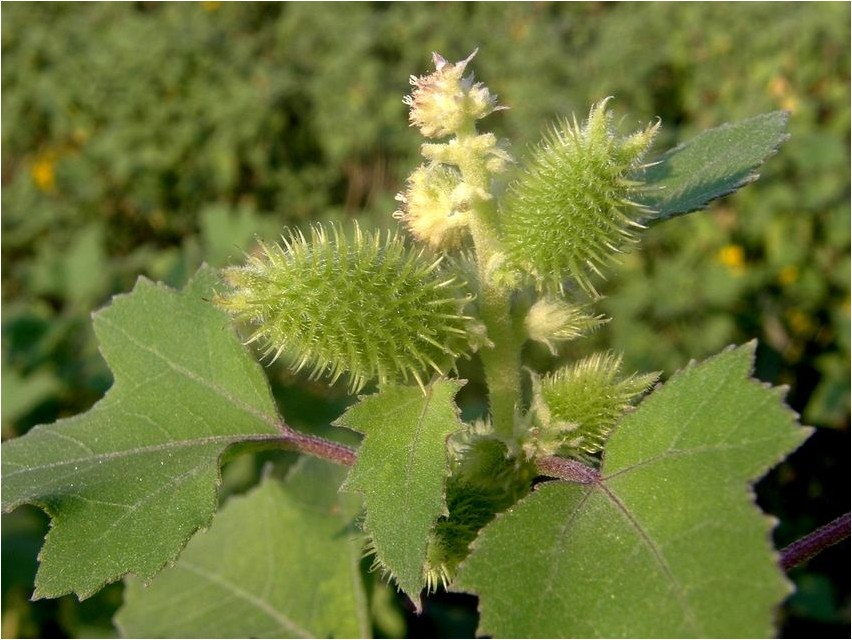
The common cocklebur is one of the plants of the family called Asteraceae or Asteraceae; in Latin the name of this plant will be as follows: Xanthium strumarium L.
As for the Latin name of the common cocklebur family itself, in Latin it will be like this: Asteraceae Dumort. (Compositae Giseke).
Description of the common cocklebur
Common cocklebur is an annual monoecious plant that will be grayish-green in color and have a rough, hairy stem. The stem of this plant is brownish and branched. The leaves are lobed and triangular, they are endowed with sharp, coarsely toothed lobes, and their base will be heart-shaped. These leaves are colored green on top and light green underneath. Flowers are collected in baskets, which can be either staminate or pistillate. The corolla will be greenish and the pistillate inflorescences are grey-green. Common cocklebur blooms from June to September.
Under natural conditions, this plant can be found in the European part of Russia and the Crimea, Southern Siberia, Central Asia and the Caucasus.
Description of the medicinal properties of the common cocklebur
The common cocklebur is endowed with very valuable healing properties, and it is recommended to use the stems, fruits, roots and leaves of this plant for medicinal purposes.
It is recommended to harvest the leaves and stems of this plant in July-August, while the fruits are collected in September-October, and the roots in late autumn. The plant is endowed with very valuable anti-inflammatory, diaphoretic, antiseptic, fungicidal, antipyretic, antispastic, sedative and analgesic effects.

As for traditional medicine, due to the fact that the plant contains a high iodine content, common cocklebur is used against goiter. A decoction of the fruits and roots of this plant, as well as the whole plant, is used for dysentery and diarrhea. The juice of the fresh herb of the common cocklebur is used for spasms in the throat, in the treatment of bronchial asthma, sore throat, goiter, hemorrhoids, abscesses in the throat, atonic dermatitis, lichen, and also malignant tumors.
An aqueous solution of this plant can be applied to those parts of the body that are covered with a rash or affected by fungi. For eczema and itchy dermatoses, an ointment should be applied externally, which is prepared from the fruits, seeds and roots of this plant.
The plant is widely used as a diaphoretic, antipyretic, and sedative for hypothermia and rheumatism. The fruits and seeds of the common cocklebur are used as ointments for scabies, eczema, itchy rashes, and insect bites. Furthermore, the fruits and leaves of this plant are used to treat paralysis. A decoction made from the roots and seeds of this plant is used to treat various bladder ailments, and the entire plant can be consumed as a tea for cancer. It is worth noting that the plant is also used in homeopathy. It is important to remember that common cocklebur is a poisonous plant, so extreme caution is recommended when using it internally and strictly follow all doctor’s instructions.
For skin diseases, goiter, rheumatism, and diarrhea, the following remedy is recommended: to prepare this remedy, take one tablespoon of dried herb per one cup of boiling water. This mixture is simmered for ten minutes over low heat, then steeped for an hour and thoroughly strained. Take one to two tablespoons four to five times daily.





