Loch
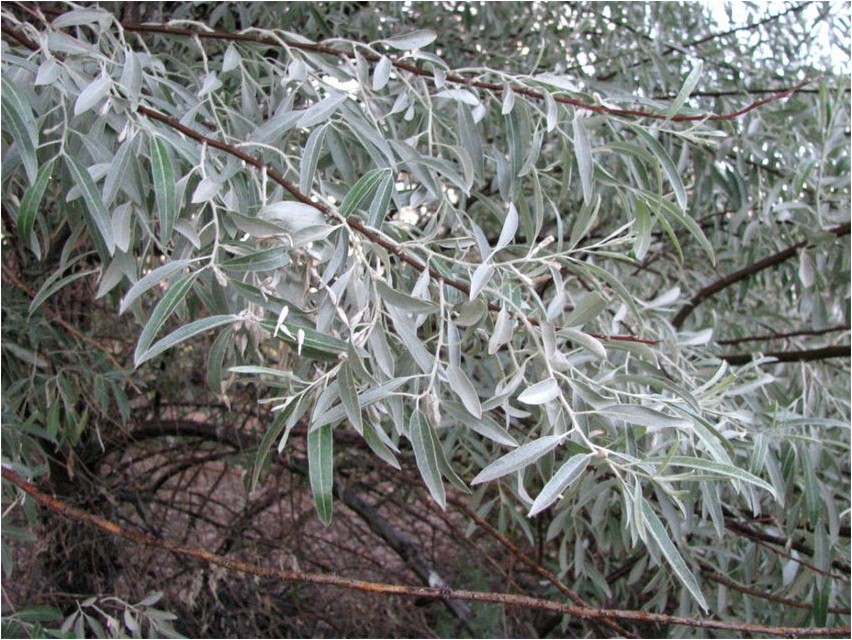
Elaeagnus (lat. Elaeagnus) is a light-loving woody plant belonging to the Elaeagnus family.
Description
The oleaster is a small dioecious or bisexual tree, most often in the form of a bush and capable of being either evergreen or deciduous. The shoots of some varieties of this plant are generously studded with numerous spines. And the leaves of the oleaster are simple, short-petiolate and alternate. They are either felt-like due to their star-shaped hairs, or silvery due to their small scales.
The small flowers of this plant emit a rather pleasant aroma. All of them are bisexual, axillary and can be either single or collected in spectacular bunches. These flowers have no petals, and their calyxes boast a very interesting four-lobed tubular-bell-shaped shape. And the fruits of the oleaster have the appearance of drupes with rather bizarre elliptical seeds, and in some varieties of oleaster the fruits are edible — their pulp is mealy and sweet in taste.
In total, this genus includes from forty to forty-five to one hundred species.
Where does it grow
Sucker is quite widespread in North America, Asia and Europe. At the same time, in Russia you can see only one single species of it — the angustifolia oleagin, and it grows mainly in the Siberian expanses or in the southeastern regions of the European part of the country.
Usage
Elf is very actively and very successfully used both in ornamental gardening and in such an important industry as agriculture, and all this is due to its incredible effectiveness and unpretentiousness.

The bright silvery shades of the amazing leaves of the oleaster make this plant an excellent basis for creating very impressive color compositions and combinations. The sucker will look especially cool when planted next to the golden varieties of deer or bladderwort, as well as the red-leaved varieties of maple, mackerel or bladderwort. Silver oleaster and angustifolia oleagin are excellent options for landscaping parks with gardens, and oleaster is often used to create excellent single-row hedges, and for this it is enough to plant a couple of plants for each linear meter of area!
Among other things, the fruits of Eleven angustifolia are edible and are quite often eaten.
Growing and care
Since oleaster is a very light-loving plant, it is recommended to plant it only in sunny areas. This plant will thrive in absolutely any garden soil, even poor ones, but areas prone to stagnant water are definitely not suitable. If you plan to plant oleaster in clayey or rather heavy soils, it is advisable to first add at least a small amount of sand. Furthermore, any substrate must be well-drained. Moreover, oleaster is considered a soil-improving plant, as it has the ability to accumulate nitrogen and enrich the soil!
Caring for oleaster is simple: it requires moderate watering, and in the spring, it is advisable to pamper this beautiful plant with complete mineral fertilizers. Sea buckthorn tolerates pruning very well, and when pruned to the stump, it produces abundant root shoots, allowing this plant to be formed into a very dense and striking hedge. Rejuvenating pruning is also recommended every fourteen to fifteen years.
Sea buckthorn can be propagated by cuttings, winter sowing, or by separating root suckers in the spring.
Sea buckthorn





