Southern dodder
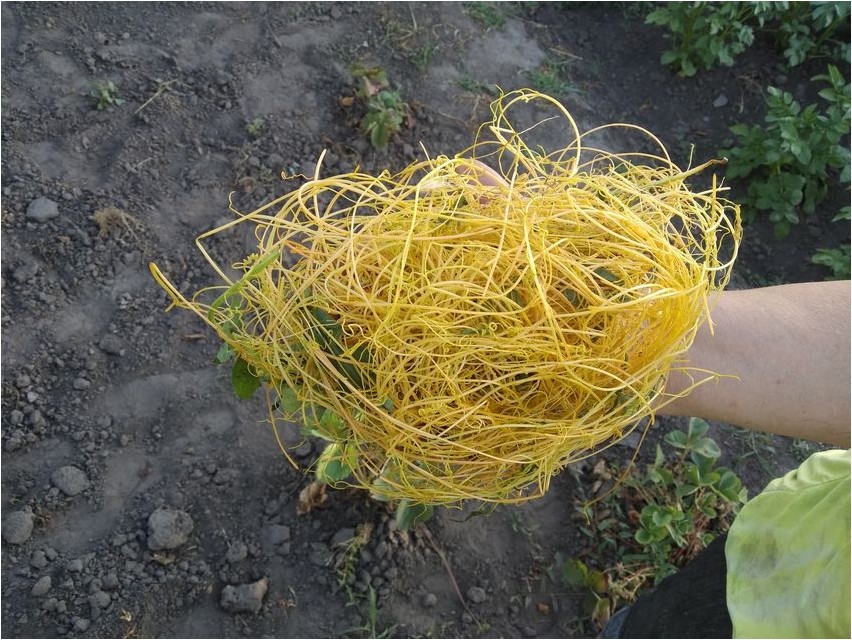
Southern dodder is one of the plants of the family called dodder; in Latin the name of this plant will be as follows: Cuscuta australis R. Brown.
As for the name of the family of this plant itself, in Latin it will be: Cuscutaceae Dumort.
Description of the southern dodder
Southern dodder is an annual plant endowed with rather thin thread-like stems, which will be smooth and branched, and such stems will be colored in orange-yellow tones. The flowers of this plant are quite small in size, their length is equal to two millimeters, they are colored in yellowish tones, and are also almost sessile or can be on rather short pedicels. Such flowers of the southern dodder will form dense balls, which will in turn be equipped with thin, blunt, lanceolate and almost transparent bracts. The corolla of this plant will be almost twice the size of the calyx, the necks will be small and endowed with rather short fimbriae, and the stigma will be capitate. The fruit of the southern dodder is a capsule that is fleshy in the upper part; such a capsule will not open correctly, and will also break into pieces or may fall off entirely from the very base.
The length of southern dodder seeds is about one millimeter. This plant will parasitize weeds or herbaceous plants, herbaceous cultivated plants, and also has the ability to damage industrial, garden, melon and ornamental crops. It should be noted that this plant is one of the most harmful weeds.
Under natural conditions, this plant can be found in the Caucasus, Central Asia, Western Siberia, the Far East, the Mediterranean, the Balkan Peninsula, Pakistan, India, Nepal, China, Australia, Ukraine and the following regions of the European part of Russia: the Black Sea, Lower Volga and Lower Don regions.
Description of the medicinal properties of southern dodder
Southern dodder is endowed with very valuable healing properties, and it is recommended to use the seeds of this plant for medicinal purposes. Such medicinal raw materials should be harvested in the autumn, when the seeds are fully ripened. The stems should be removed from the plants, then dried in the sun and the seeds beaten. The presence of such valuable healing properties is recommended to be explained by the content of stigmasterol, beta-amyrin, cholesterol, beta-sitosterol and campesterol in the seeds of this plant.

In China, the following healing remedy based on this plant has become quite widespread: to prepare such a remedy, you will need to take a certain amount of southern dodder seeds. Such seeds are sifted through a sieve, and then they begin to fry until the color of the seeds changes to gray-brown and they look like a thick paste. After this, such raw materials should be crushed well and a flat cake is prepared from it, cut into pieces and then dried in the sun.
In case of severe anxiety of the fetus in the womb, general loss of strength, too frequent urination, darkening of the eyes, dizziness, loss of semen, aching in the lower back and hip joints, it is recommended to use the following very healing remedy based on this plant: to prepare such a remedy, take six to fifteen grams of cakes and make a powder from them. This healing remedy based on this plant should be taken with boiled water. It should be noted that Chinese medicine widely uses this healing agent and it turns out to be very effective when used correctly.