Heliconia
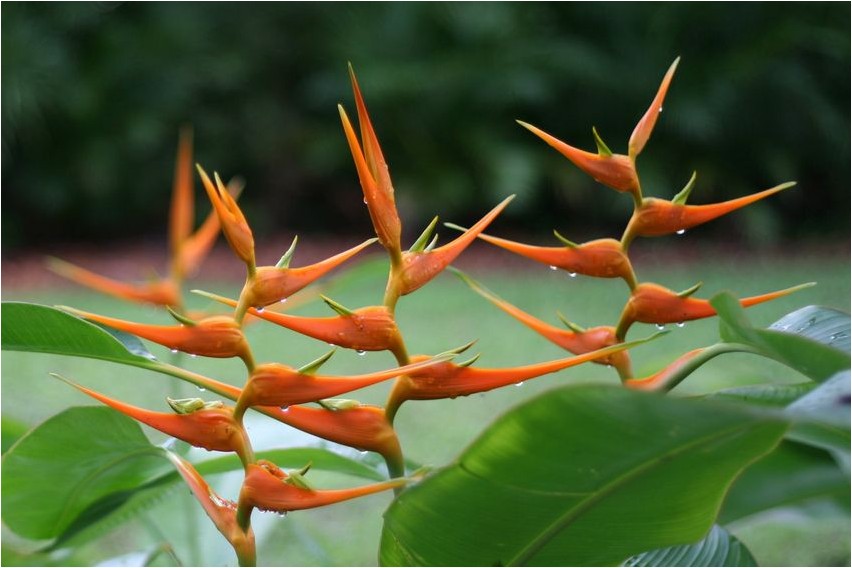
Heliconia (Latin: Heliconia) is a houseplant; a herbaceous plant of the Heliconiaceae family.
In the wild, heliconia is found in tropical forests, on seashores and riverbanks, and on mountain slopes in Southeast Asia, Central and South America. The plant gets its name from Mount Helikon.
Cultivate Characteristics
Heliconia is a perennial rhizomatous plant up to 2. 5-3 m tall, with a distinct pseudostem formed by broad, oblong-oval leaves and leaf sheaths. Heliconia is a fast-growing plant, blooming in the second year after planting. Almost every root segment that bears the pseudostem and leaves produces inflorescences. Inflorescences can be of two types: pendulous and upright.
The flowers are brightly colored bracts of red, orange, yellow, or pink with a waxy coating. The bracts have a green or yellow border, giving the inflorescences a particularly decorative appearance. The true flowers are enclosed within the bracts; they are not very showy, opening in the morning and blooming for only one day. Because of the unusual structure of the inflorescences, heliconia is often called lobster claw, parrot’s beak, false bird of paradise, or wild banana.
Care

Heliconia is a light-loving plant, preferring rooms with bright, filtered light. It can easily tolerate direct sunlight for short periods. The optimal temperature for normal development is 22-26°C (72-79°F) in summer and 18-20°C (64-68°F) in winter. Drafts and stagnant air are unfavorable for this plant; careful ventilation is essential.
In nature, heliconia is a tropical rainforest native, so maximum air humidity (80-90%) is essential for its growth. In low humidity conditions, the plant requires regular misting with warm, settled water. You can also place the heliconia pot on a wide tray filled with damp expanded clay.
Propagation and Planting
Heliconias are propagated by seeds, layering, and rhizome division. Sow the seeds in containers filled with a soil mixture of peat and sand. Before sowing, germinate the seeds by soaking them in hot water (60-70°C) for at least 3-4 days. Plant the seeds no more than 2 cm deep. Until germination, keep the containers in a room with a temperature of 25-27°C. Mist and ventilate the plants periodically. Germination is usually uneven, and this can take 3-5 months.
During vegetative propagation, separation of root shoots is carried out only from a plant with a well-developed root system. The offspring are planted in pots filled with a moist substrate and placed in a warm, slightly dark place with high air humidity. With the appearance of young growths, the plants are transferred to window sills or other illuminated places.
Transplant
Heliconia is replanted every spring. The pots are wide, 5-6 cm larger than the previous ones. The bottom of a pot or any other container provides good drainage. The soil substrate is made up of humus, leaf and turf soil and river sand in a ratio of 2:1:1:1.
Care
Heliconia is moisture-loving and needs abundant watering in the spring and summer. In winter, watering is reduced, but care is taken to ensure that the earthen ball does not dry out completely. Fertilizing with complex mineral fertilizers is carried out from March to September once a month. During the dormant period, heliconias are not fertilized.
Heliconia is often affected by diseases and pests. Scale insects, which suck cell sap from the leaves, are especially dangerous for the plant. Plants become faded and unattractive, leaves dry out and fall off. To combat the pest, the leaves are treated with a soap solution, and then sprayed with a 0. 15% solution of the drug “Actellik”. Spider mites are fought in the same way.