Vampy
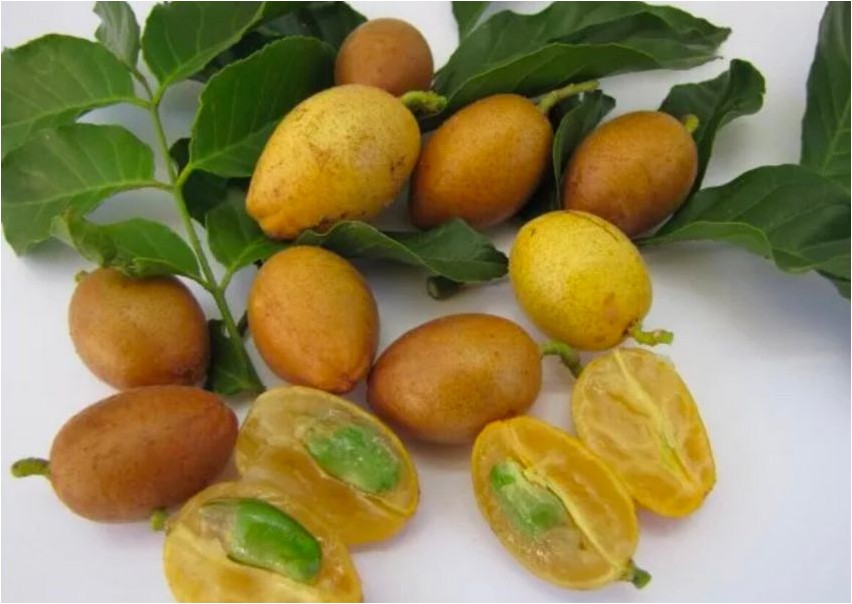
Vampi (lat. Clausena lancium) is an evergreen and relatively low tree crop from the Rutaceae family, which is a distant relative of Citrus.
Description
Vampi is an evergreen tree growing up to six meters in height with incredibly flexible (almost like willow) branches. It boasts resistance to minor frosts (down to minus two degrees), but if the thermometer drops below minus six degrees, the wampi will quickly die.
The unusually resinous, spirally arranged leaves of this culture are distinguished by their elliptical shape and reach a length of ten to thirty centimeters.
Wampi fruits always grow in spectacular clusters and reach two and a half centimeters in diameter. Each fruit is covered on top with a thin yellowish-brownish shell, and the flesh inside the fruit, divided into five separate segments, is colored yellowish-white. In almost every segment you can find one bright green seed. Moreover, the seeds often occupy up to fifty percent of the total volume of wampi.
Currently, there are several varieties of this attractive crop, differing both in the taste of the fruit and in their shape. By the way, the taste of these fruits can be either sickly sweet or sour. Basically, the fruits of this amazing plant are distinguished by either sweet and sour or sweet taste with a slightly pungent aftertaste.
Wampi bears fruit only once a year. But, despite its relatively compact dimensions, each tree is capable of producing up to forty-five kilograms of fruit per season under particularly favorable conditions.

Where does it grow
Wampi is a fruit native to Southern China and Indochina. It is mainly cultivated there to this day. In addition, wampi plantations can be found in Malaysia, Indonesia or India, as well as on the luxurious Hawaiian Islands, colorful Sri Lanka and the Philippines. This culture can be seen a little less often in Australia and in a number of countries with subtropical and tropical climates.
As for the USA and Europe, no one there paid attention to this unusual culture for a long time. Only after a detailed chemical analysis of the composition of its fruits did the wampi begin to penetrate their territory.
Application
The main distinguishing feature of wampi is the surprisingly low calorie content of its pulp — only 1 kcal per 100 g of fruit! So, by consuming these fruits, you should not be afraid of gaining weight.
Vampi is consumed fresh, and is also added to all kinds of dessert dishes and a wide variety of salads. These juicy fruits will be an excellent filling for pies, as well as an excellent base for making confitures, jelly or jam. And Chinese national cuisine is famous for its wonderful side dishes for meat prepared with the addition of wampi.
In a number of countries in Southeast Asia, juice is obtained from wampi, which is then combined with sugar and fermented, bottled and properly capped — a few months later you can enjoy the taste of the original low-alcohol and highly carbonated drink, somewhat similar to champagne.
In addition, wampi are rich in ascorbic acid and are famous for their unique healing properties. Raw fruits are endowed with the ability to have a powerful anthelmintic effect and help not only in curing ailments of the gastrointestinal tract, but also in their prevention. And the Chinese and Vietnamese often use halves of fruits dried in the sun for bronchitis (as an excellent expectorant and quickly soothing drug).
Wampi leaves are also famous for their healing properties — they are widely used to prevent the appearance of premature gray hair, as well as dandruff and even baldness: a decoction of the leaves is an excellent means for washing your hair!
Contraindications
Vampi has no contraindications as such, but occasionally an allergy may occur when consuming these fruits.