Horse chestnut
Horse chestnut is one of the plants of the family called horse chestnut; in Latin the name of this plant will be as follows: Aesculus hippocastanum L.
As for the name of the horse chestnut family itself, in Latin it will be like this: Aesculaceae.
Description of horse chestnut
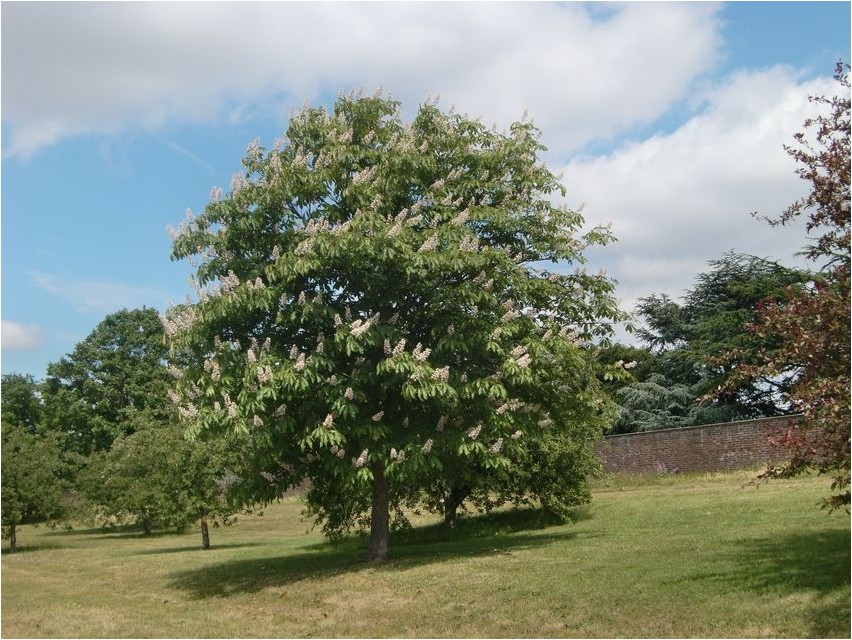
Horse chestnut is a tree whose height reaches about thirty meters. This plant will be endowed with a wide and dense crown, and the bark will be colored in dark brown tones. The leaves are large, they are located oppositely on rather long grooved petioles. The horse chestnut leaf blade is deeply palmately divided into obovate, finely toothed lobes, which gradually taper towards the base, and at the apex they will be short-pointed and uneven along the edge. The flowers of this plant are very fragrant, they are symmetrical and quite numerous. Such flowers are on long stalks and are painted in white and pink tones: the flowers will be collected in large pyramidal clusters. The fruit of the horse chestnut is a round capsule, which will be seated with thorns, and inside there are one or two shiny seeds, colored in brown tones.
Horse chestnut blooms from May to June, and the fruits will ripen around September-October. As an ornamental plant, horse chestnut will be cultivated in the southern and central zone of the European part of Russia, in the Crimea, the Caucasus, Ukraine and Central Asia. The birthplace of this plant is the Balkan Peninsula.
Description of the medicinal properties of horse chestnut
Horse chestnut is endowed with very valuable healing properties, and it is recommended to use the bark, flowers, seeds and peel of this plant for medicinal purposes. The flowers should be collected around May-June, the bark is collected in early spring, and the seeds are harvested when ripe. It is noteworthy that horse chestnut flowers can be used both fresh and dried, and the seeds can only be used fresh.
The presence of such valuable healing properties should be explained by the content of coumarin, triterpene glyoxide escin, saponin, starch, tannins, sterols, fatty oil, esculetin and its glycoside esculin, as well as the following flavone glycosides: quercetin, kaempferol, quercitrin and isoquercitrin. Horse chestnut leaves contain rutin, spireoside, quercitrin, quercetin, isoquercitrin, as well as the cotinoid lutein and violaxanthin. The flowers of this plant contain the following flavonoids: derivatives of quercetin and kaempferol.

It should be noted that this plant is widely used in folk medicine in many countries. A decoction and infusion prepared from the bark of this plant are endowed with astringent, analgesic, anticonvulsant, hemostatic and anti-inflammatory effects. An infusion of horse chestnut flowers has an analgesic and anti-inflammatory effect, the seeds have an anti-inflammatory effect, and the seed peel has an analgesic and anti-inflammatory effect.
In folk medicine, a decoction of the bark of this plant is used as a fairly effective external and internal remedy in the treatment of hemorrhoids, colitis and chronic enterocolitis, diarrhea, gastritis with increased acidity of gastric juice, bronchitis, diseases of the spleen and runny nose, which will be accompanied by pronounced severe inflammation of the mucous membrane of the throat. In addition, such a decoction can be used as a very effective hemostatic agent for a variety of bleeding, and this is especially true for uterine bleeding.