Rubia cordifolia
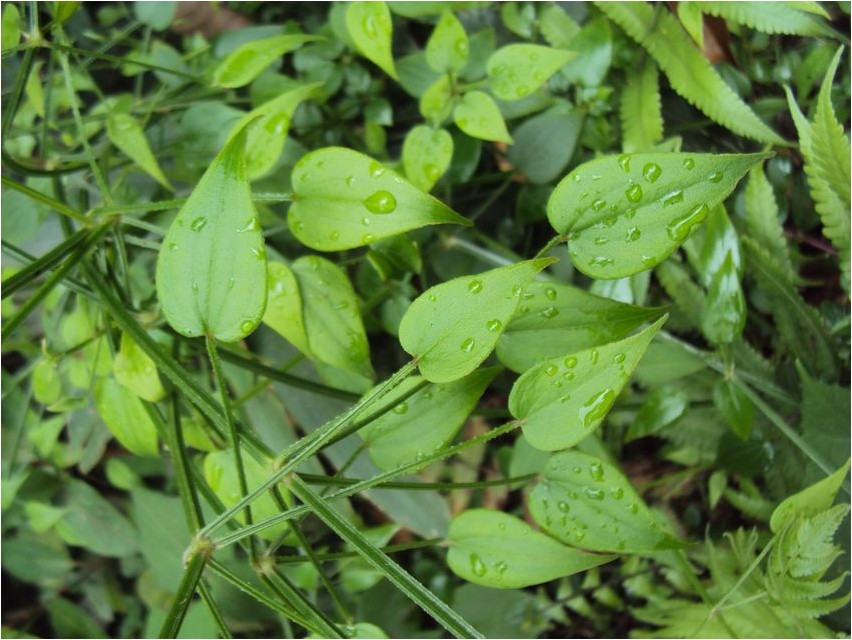
Rubia cordifolia is a member of the bogbean family. Its Latin name is Rubia cordifolia L.
The Latin name for the Rubia cordifolia family is Menyanthaceae Dumort.
Description of Rubia cordifolia
Rubia cordifolia is a perennial herbaceous plant that can reach a height of two meters. Its rhizome is branched, creeping, very thin, and repeatedly twisted. The base of the Rubia cordifolia roots forms a complex yet compact interlacing network, up to seven centimeters long and wide. The upper stems of this plant are weak, spreading, tetrahedral, and geniculate, with long internodes. The leaves of Rubia cordifolia are whorls of six to eight leaves, located at the lower and middle nodes. The inflorescences of this plant are arranged at the ends of the stem and branches in sparse, up to twenty-five centimeter-long panicles, which are more or less leafy. These inflorescences form through semi-umbels, and the corolla is quite small, with a diameter ranging between three and a half and four and a half millimeters. This corolla is pale yellow and bell-shaped. The fruits of this plant are approximately four and a half millimeters long.
The flowering period of the heart-leaved madder begins in June and ends in August, while the fruits ripen from August to October. In the wild, this plant is found in the Primorye and Amur regions of the Far East, as well as in the Angara-Sayan and Daurian regions of Eastern Siberia. This plant prefers meadows, forest edges, forests, coastal shrub thickets, and rocky and craggy slopes.
Description of the medicinal properties of heart-leaved madder
Cord-leaved madder is endowed with highly valuable medicinal properties. The fruits, rhizomes, leaves, and stems of this plant are recommended for medicinal purposes.
The presence of such valuable healing properties should be explained by the content of cardenolides and triterpenoids in the plant: rubifolic and rubiconmaric acids. As for the rhizomes of this plant, there are coumarins and the following anthraquinones: purpurin, lucidin, alizarin, rubiadin, ruberythric acid, pseudopurpurin, rubiadin primveroside, nordamcantol, fiscin and mollyugin. The aerial part of Merana cordifolia contains coumarins, flavonoids and the following iridoids: asperuloside and desacetylasperuloside.

Infusion and decoction prepared from the rhizomes of this plant have become quite widespread in Korean, Indian, Tibetan and Chinese medicine. Such healing agents are used for amenorrhea, various gynecological diseases, dysmenorrhea, leucorrhoea and endometritis.
As for Tibetan medicine, powder and decoction of madder rhizomes are widely used. This healing agent is used for exudative pleurisy, laryngitis, pneumonia, tuberculosis, kidney and liver diseases, anthrax, smallpox, headaches, lung abscesses and complicated diseases of the digestive system. Also, rhizomes are present in drugs that are recommended for use as prototypes of drugs that regulate salt metabolism. It should be noted that such a healing remedy based on madder cordifolia turns out to be very effective.





