Anabasis aphylla
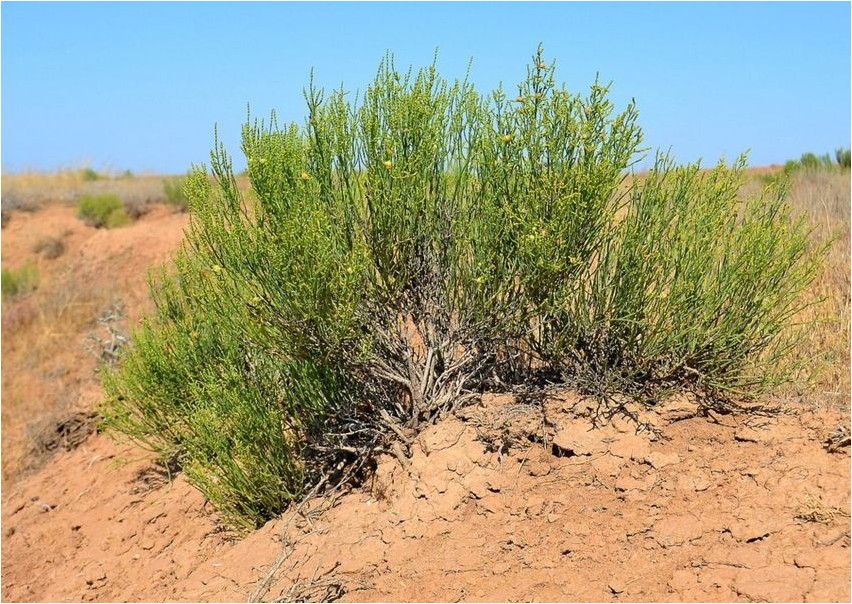
Anabasis aphylla is a member of the Chenopodiaceae family. Its Latin name is Anabasis aphylla L.
The Latin name of this plant’s family is Chenopodiaceae Vent.
Description of Anabasis aphylla
Also known as Anabasis, this plant is a perennial subshrub, reaching heights between thirty and seventy centimeters. Its rootstock is woody. Its stems are woody and bushy from the base. Annual shoots are segmented, succulent, leafless, and cylindrical. Its flowers are quite small, pink or white in color. These flowers are borne in spike-like inflorescences at the ends of stems and branches. The flowering period of the blackberry is from August to September. This plant produces a berry-like fruit. It is worth noting that all parts of the blackberry are poisonous, and therefore, caution should be exercised when handling the blackberry.
In the wild, this plant can be found in the European part of Russia: in the southern Lower Don and Lower Volga regions, as well as along the Sea of Azov. It also grows in Central Asia and the Caucasus. The blackberry prefers solonetz, solonchakous loess-like sierozems, solonchaks, fine-grained slopes, and sand with nearby saline waters, at altitudes up to 1, 400 meters above sea level. The plant can grow in groups or thickets. Description of the medicinal properties of blackberry leafless
Blackberry leafless has very valuable medicinal properties. For medicinal purposes, the above-ground part of this plant should be used, which should be cut at the very base of the stem. It is recommended to dry the above-ground part in the open air until the branches become stiff and brittle.
In addition, you can also use the roots of leafless blackberry: such roots contain pectins, alkaloids, organic acids and carbohydrates. As for alkaloids, the most important thing here is the content of anabasine, which in its physiological action and chemical properties will be very similar to nicotine. Like nicotine, anabasine first excites and then paralyzes the autonomic ganglia and related formations.
In medicine, derivatives of anabasine and other alkaloids are also used: lupicaine, methylanabasine and nicotinic acid, which is called 3-pyridinecarboxylic acid. Methylanabasine is used as a respiratory stimulant, niacin is used as a specific agent against pellagra, and lupicaine is a fast-acting local anesthetic. It is noteworthy that such a remedy will exceed the duration of the effects of cocaine.

As for veterinary medicine, the aqueous extract of this plant is used to treat a variety of skin diseases of livestock. It should be remembered that anabasine can penetrate the skin and even cause poisoning, and two or three drops of this substance is a lethal dose for humans.
It is noteworthy that anabasine is widely used in the national economy, where this substance is used to control numerous crop pests. Here this substance is used as 40% anabasine sulfate: this is a liquid mixture of sulfuric acid salts of a dark brown color, the supply of which will resemble nicotine.
Leafless Anabasis plant (lat. Anabasis aphylla)
Blackberry leafless blackberry