Maakia Amur
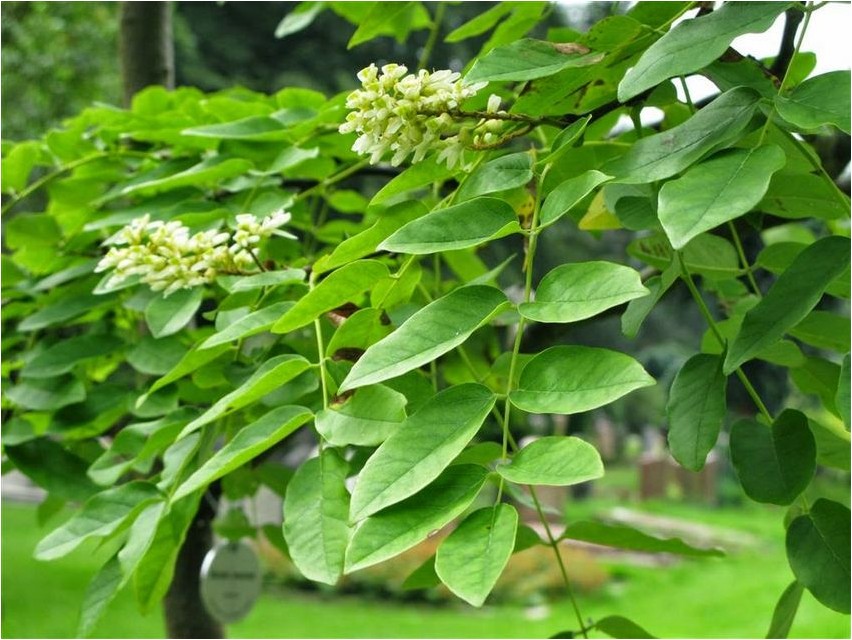
Amur maackia is one of the plants of the family called legumes; in Latin the name of this plant will be as follows: Maackia amurensis Rupr. et Maxim.
As for the name of the Amur maakia family itself, in Latin it will be: Fabaceae Lindl. (Leguminosae Juss.).
Description of Amur maakia
Maakia Amur is a tree whose height will vary between ten and twenty-five meters, and its age can reach about two hundred to five hundred years. The diameter of this plant will be about forty centimeters. Maakia Amur will be endowed with a rather dense crown and a straight trunk, which will be covered with a shiny and sometimes lagging crown, painted in light brown tones. It is noteworthy that this plant can also be a shrub, the height of which is one and a half to five meters.
The lenticels of this plant will be warty, they will be collected together in several pieces. Adult leaves of Amur maakia will be odd-pinnate, their length is about ten to thirty centimeters, they are endowed with three pairs of leaflets. The leaves of this plant are ovate, dark green on top and light green underneath. The inflorescence of Amur maakia is a thick brush, its length will be about fifteen to eighteen centimeters. The flowers of this plant will be on short stalks, the length of which will be about three millimeters. The calyx consists of five sepals, with the top two fused into one. The petals of the Amur maakia are painted white, their length is about ten to eleven millimeters, and their width is six millimeters. The beans are flat, they are endowed with three longitudinal ribs, which are located along the upper edge, and they are painted in dark brown tones.
Amur maakia blooms in July, and fruiting will take place in September. Under natural conditions, this plant is found in all regions of the Far East, with the exception of Sakhalin and Kamchatka. For growth, Amur maakia prefers river banks, forests, forest edges, hills, plateaus, places among bushes, meadow slopes, alluvial and deluvial rich soils. The plant is not only decorative, but is also a very valuable honey plant.
Description of the medicinal properties of Amur maakia
Amur maakia is endowed with very valuable healing properties, and for medicinal purposes it is recommended to use the bast, bark and leaves of this plant. The presence of such valuable healing properties should be explained by the content of tannins, saponins, vitamin C and vitamin P in this plant, as well as the alkaloid lupanine and cytisine. As for traditional medicine, a decoction prepared from the bark of this plant is quite widespread. This decoction of Amur maakia bark is recommended for use as a painkiller, and a decoction of the leaves and bark is used to treat tumors.

It should be noted that bast is part of a wound-healing ointment; its powder can be used to sprinkle on deep wounds and ulcers that do not heal for a long time. It is recommended to rub calluses and warts using freshly cut roots of Amur maakia.
It is noteworthy that the wood of this plant turns out to be very suitable for turning products, as well as for the manufacture of bent furniture.
To treat tumors, it is recommended to use a very effective remedy based on this plant: to prepare such a healing remedy, you will need to take three tablespoons of dry crushed leaves of Amur maakia per half liters of boiling water. This mixture should be infused for two to three hours, and then this mixture is filtered. Take the resulting product three times a day, one-third of a glass.





