Cayenne Pepper
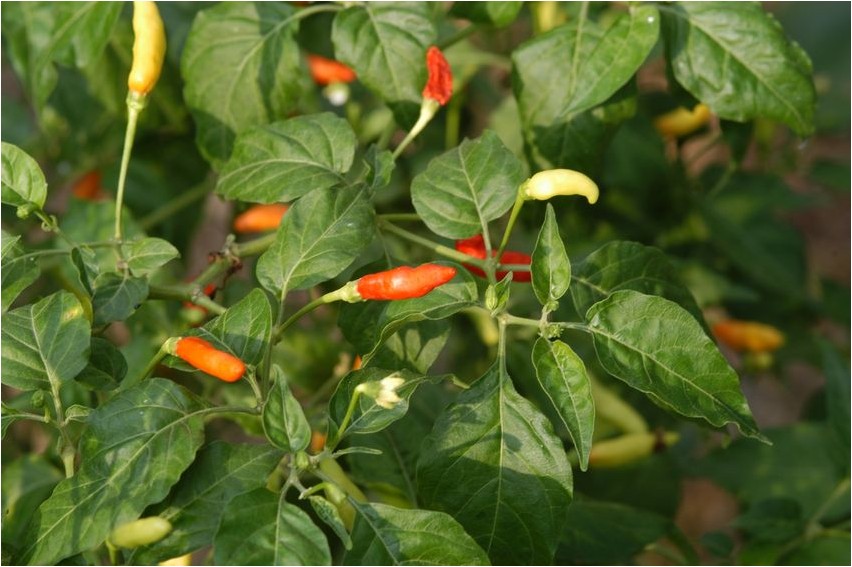
Cayenne pepper (Latin: Capsicum annuum “Cayenne”), or chili pepper, is an agricultural crop distinguished by its relatively high capsaicin content. The first harvests of cayenne pepper were collected as early as the 6th and 7th centuries CE.
History
The homeland of cayenne pepper is considered to be tropical America. At least, this is supported by evidence found in Peruvian burials. Pepper cultivation began in this region long before the arrival of Europeans in the Americas. Today, hot peppers are grown in virtually every country. They are especially common in Mexico, Thailand, and India.
Description
Cayenne pepper is a plant that often reaches a height of one and a half meters. Young shoots of cayenne pepper are greenish in color, with slight purple hues visible at the nodes. The shoots are usually bare, but sometimes they can be pubescent. The light brown bark of the plants is characterized by a slight roughness.
The smooth leaves of cayenne pepper, reaching fifteen to twenty centimeters in length, are elliptical and arranged alternately.
The flowers on the plant are either white-purple or completely white. Incidentally, cayenne peppers typically bloom and fruit throughout the year. However, their most abundant flowering occurs in June, and fruiting occurs in August.
The fruits of cayenne pepper are berries with thin, juicy pericarps, the shape of which can vary from trunk-shaped to spherical. Capsaicin, contained in the fruits, gives them a distinctly bitter taste.

Unripe fruits are typically purple or greenish in color, while ripe peppers can be red or yellow, or black, white, or purple. Harvesting and Storage
Ripe cayenne peppers are harvested and dried in direct sunlight before being ground into powder. The powder is typically grayish-yellow or deep yellow.
Dried cayenne pepper should be stored in glass containers with airtight lids.
Cultivation
Cayenne pepper can be easily grown indoors and consumed fresh with caution. However, it is most often grown in home gardens.
In general, growing cayenne peppers is similar to growing bell peppers or tomatoes. In principle, this is not surprising, because these cultures are related. This plant will do best in greenhouses. Seeds for its cultivation are usually prepared in advance and planted indoors as early as February. Ideally, cayenne pepper should be located near windows as it needs good lighting.
As soon as the seedlings grow up and a pair of true leaves appear on them, they are planted in individual pots. And plants that have reached ten to fifteen centimeters in height can be safely transplanted into greenhouses. Some gardeners grow cayenne pepper in fairly large pots, which, if necessary, can always be moved under cover (for example, if the thermometer drops below ten to twelve degrees at night).
Air humidity also plays an important role in the successful development of cayenne pepper. When hot weather sets in, plants need to be watered daily in the mornings or evenings.
As for fertilizing, cayenne pepper is very unpretentious — it will be quite enough for it to add ash and humus in the fall.
Cayenne PEPPER beneficial properties and uses