Dendrobium phalaenopsis
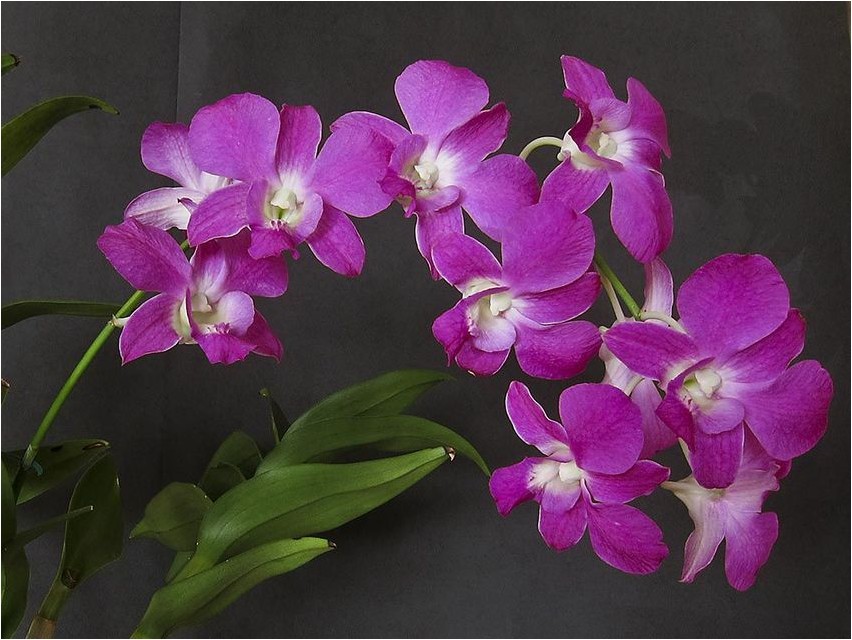
Dendrobium phalaenopsis is also known under such names as dendrobium bigibbum, moth dendrobium and even dendrobium two-humped.
In Latin, the name of this plant is as follows: Dendrobium phalaenopsis. This plant belongs to the family called orchids, in Latin the name of this family will be: Orchidaceae.
Description of the features of growing dendrobium phalaenopsis
For favorable development of Dendrobium phalaenopsis, it will be necessary to provide partial shade. It is noteworthy that in the summer the plant will require abundant watering. At the same time, air humidity should be average. The life form of this plant is an epiphyte.
Dendrobium phalaenopsis is recommended to be grown in winter gardens, greenhouses, and also in display windows. As for growing plants indoors, you should choose the lightest windows. It is worth noting that in cultivation the maximum height of this plant can reach about sixty centimeters.
As for replanting, the plant will need it as both decay and compaction of the substrate occur. It is important to remember that Dendrobium phalaenopsis should be extremely carefully protected from unwanted damage to the roots. In this case, you will need to select the following composition of the soil mixture: sphagnum and fern roots, in this case you should take two parts of roots and one part of sphagnum. It is recommended to add a little more charcoal to this soil. It is worth noting that sometimes it is quite acceptable to use pieces of pine bark and dry leaves instead of fern roots. In this case, the size of such pieces should be about half a centimeter to one and a half centimeters. As for the acidity of the soil, it can be either slightly acidic or acidic.
It is important to remember that Dendrobium phalaenopsis is quite often affected by scale insects. In addition, you should under no circumstances allow any sudden changes in the conditions of keeping this plant. The slightest overdrying of the plant is also extremely undesirable. During the dormant period, Dendrobium Phalaenopsis will need to provide an optimal temperature of eighteen degrees. The plant needs moderate watering, and air humidity should also be average. Under indoor conditions, the plant’s dormant period will be forced: this period occurs from October to February. In all other cases, there is no dormant period for phalaenopsis dendrobium.

Plant propagation can occur either by sowing seeds or by dividing during planting. It is worth noting that sowing seeds is chosen much less frequently. It is important to note that Dendrobium phalaenopsis is a fairly heat-loving plant, but its maintenance conditions should be uniformly warm throughout the year.
Not only the flowers, but also the leaves of this plant have unique decorative properties. The leaves of Dendrobium phalaenopsis are lanceolate, they can reach even twenty centimeters in length, and they are about three centimeters wide. The leaves of the plant are arranged alternately on the upper half of the so-called stem-shaped bulb.
As for the color of the plant’s flowers, they can be either pink, lilac or crimson. On the rather long peduncle of the plant there is a brush; this brush can contain up to fifteen flowers. The length of the peduncle will be about half a millimeter. It is worth noting that today in culture there are quite a lot of garden forms and various hybrids of this plant. The main difference between these plants is the color of their flowers, as well as the duration of flowering and the timing of flowering. It is noteworthy that in some cases the flowering of this plant can continue for six months.