Toothwort tuberous
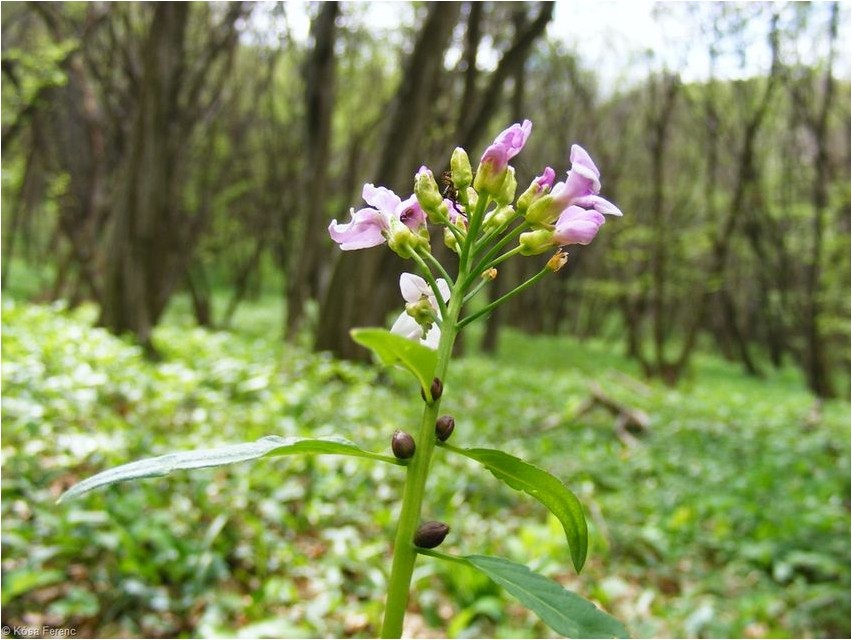
The tuberous densum is one of the plants of the family called cruciferous; in Latin the name of this plant will be as follows: Dentaria bulbifere L.
As for the name of the tuberous catfish family itself, in Latin it will be: Brassicaceae Burnett or Cruciferae Juss.
Description of the tuberous cathode
The tuberous toothfish is also known by such popular names as toothfish, toothfish, live bait, zhibec and woman’s teeth. Toothwort is a perennial herbaceous plant whose height will vary between thirty and seventy centimeters. The stem of this plant is endowed with quite numerous alternate leaves, in the axils of which there will be bulbs painted in black tones. The lower leaves of the tuberculum are pinnately dissected, and the upper leaves will be entire. The flowers of this plant are quite large; they can be colored either pink or lavender. The calyxes of this plant consist of two pairs of falling leaves, and the corolla will consist of petals that are arranged crosswise. There are only six stamens, and the pistil will consist of two carpels and it is divided into two nests by means of a lamellar placenta. The fruit of the tuberous catfish is a linear, flattened pod. Reproduction of this plant occurs through bulbs. It should be noted that tuberous catfish will rarely bear fully developed ripe fruits.
The flowering of tuberous catfish occurs in the spring. Under natural conditions, this plant is found in Moldova, the Caucasus, Crimea, as well as in the following areas of the European part of Russia: the Volga region, the Black Sea region and the North-West. In addition, the tuberous catfish can be seen in the Black Sea region, the Carpathians and the Dnieper region of Ukraine. As for its general distribution, this plant is found in Scandinavia, Central Europe, Atlantic Europe, Scandinavia, the Balkans, Iran, Asia Minor, as well as in the western and eastern Mediterranean. For growth, this plant prefers shady broad-leaved forests. It should be noted that this plant is also quite decorative.
Description of the medicinal properties of tuberculum
The tuberous densum is endowed with very valuable healing properties. For example, a decoction prepared from the roots of this plant is recommended for use for colic in children, as well as for tetanus and dysentery.
For dysentery, tetanus and children with colic, it is recommended to use the following remedy based on the tuberculata: to prepare such a remedy you will need to take one tablespoon of crushed dry roots of this plant per three hundred milliliters of water. The resulting mixture should be boiled for about seven to eight minutes, and then this mixture is left to infuse for one hour, after which it is recommended to strain this mixture very carefully. Take the resulting remedy based on tuberculosis, half a glass or one third of a glass three times a day for tetanus and dysentery. As for the fight against colic in children, in this case children should be given from one teaspoon of the resulting mixture to one tablespoon, depending on the age of the children. When fighting colic, this remedy should be taken three times a day. It should be noted that in order to ensure the greatest effectiveness when taking such a remedy based on chives, it is important to strictly follow not only all the standards for the preparation of such a remedy, but also follow all the rules of administration.





