Codonanta
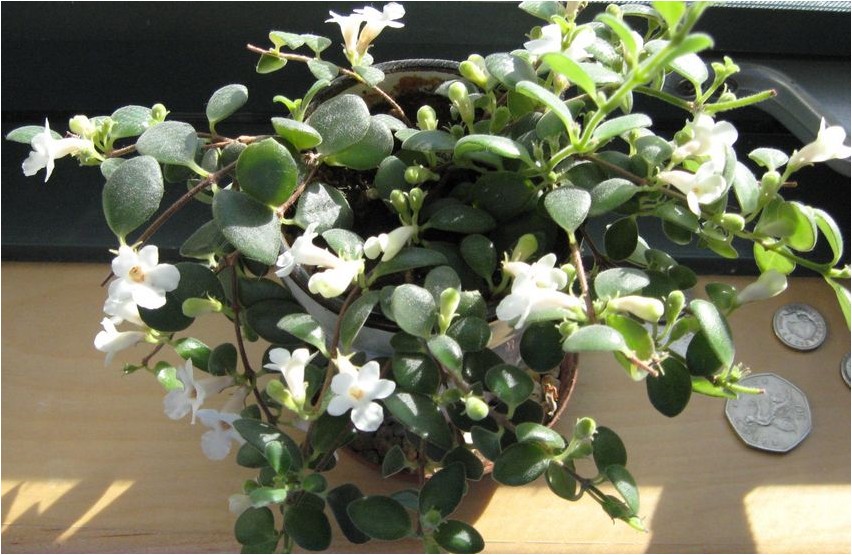
Codonantha (lat. Codonanthe) is a flowering plant that is the brightest representative of the Gesneriaceae family.
Description
Codonanta is a beautifully flowering perennial that can take the form of shrubs, herbs or vines. Its spreading stems can be either upright or creeping, and sometimes there are specimens with stems that become lignified at the base. They usually take root in nodules.
Equipped with fleshy plates, leathery opposite leaves sit on short petioles, and the flowers of this plant can be either single or collected in luxurious axillary inflorescences – each such inflorescence includes from one to several flowers sitting on short peduncles. The corollas of these flowers can be white, yellow, lilac, pink or dark purple.
The fruits of codonanta are capsules that look like rather fleshy berries. These berries can be either oval or round, or flattened, and the variety of their color options simply cannot fail to impress – there are green, yellow, orange, pink, and red berries! As for the seeds, they are characterized by an elliptical shape, the presence of stripes and a yellow, pink or red color.
Where does it grow
The homeland of codonanta is considered to be South and Central America. This unpretentious beauty especially often grows in ant nests.
Usage
Most often, codonanta is grown as a houseplant or hanging plant. And in temperate climates it is usually planted in greenhouses.

Growing and care
Caring for codonanta is so simple that even a beginner can easily cope with this task. It is best to plant this plant in nutritious and fairly loose soil, characterized by good air and water permeability. It will be very useful to add a little crushed limestone, as well as the bark of coniferous trees and leaf soil. And at the very bottom of the pot they arrange good drainage from shards or an expanded clay layer. As for the temperature regime, the codonant will feel best at a temperature of nineteen to twenty-two degrees.
Despite the fact that the codonanta is very photophilous, it cannot tolerate direct rays of the sun. It should be watered regularly and moderately, trying to avoid excessive drying. But water should not stagnate in the pan either – this can lead to big troubles for the plant.
During the active growth period, codonanta also requires fertilization. With the onset of spring, it should be fed once every two weeks with a liquid complex fertilizer. Beginning toward the end of autumn and continuing until February, when the codonanta enters dormancy, watering is significantly reduced, and all fertilizing is discontinued.
After the codonanta has finished flowering, its shoots should be pruned to limit its excessive spread. This beauty is repotted annually or every other year in fresh soil. Incidentally, ready-made soil for Saintpaulia violets is also suitable for this purpose.
This attractive plant is usually propagated by cuttings, which should be between ten and fifteen centimeters long. These cuttings can be rooted in either light soil or water. Typically, two to four cuttings are planted in a single container.
Codonanta can occasionally be attacked by mealybugs. Spider mites are also not averse to this plant, and significant temperature fluctuations combined with overdrying of the substrate can cause leaf drop.