Cumbria
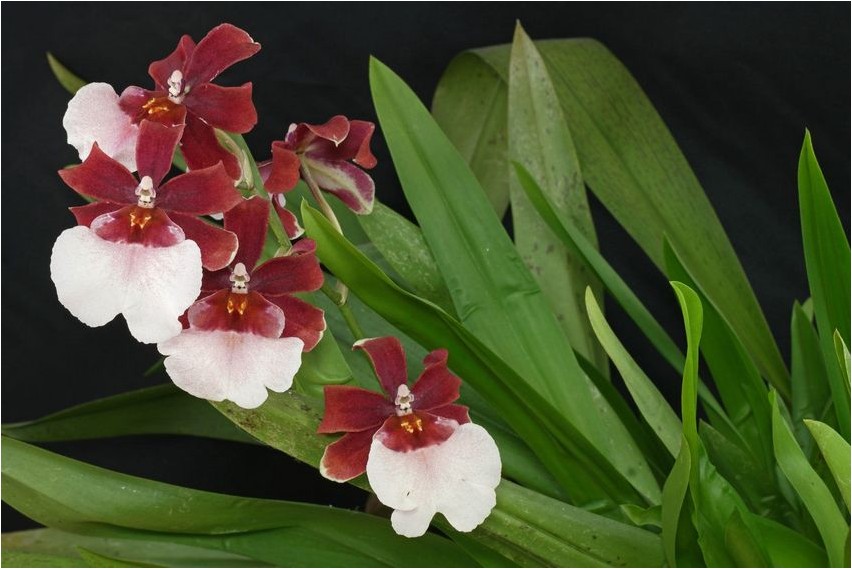
cambria (lat. Cambria) is a herbaceous plant of the Orchidaceae family; a complex hybrid of different types of orchids, in particular miltonia, cochliodes and odontoglossum.
Cambria has the characteristics of all three plants: from the first the plant received a painted lip, from the second – a bright and rich color, from the third – a star-shaped shape. Cambria was bred specifically for home floriculture, so the plant feels great in indoor conditions and does not require special conditions. Another name for vuilstekear.
Characteristics of culture
Cambria is a sympodial orchid with developed oval or fusiform pseudobulbs about 8 cm long. The leaves are dark green, broadly lanceolate, with a pronounced central vein, tightly packed to each other, up to 50 cm long. The flowers are large, red with white specks, reaching 8-10 cm in diameter. Flowering lasts 6-8 weeks.
Each pseudobulb blooms once and produces 1-2 peduncles. At the end of flowering, Cambria begins to form new pseudobulbs, from which new peduncles are formed. Cambria roots grow not only inside the pot, but also on top of the substrate. Cambria is a spectacular plant, it blooms very profusely and beautifully, and with proper care, flowering is observed several times a year.
Conditions of detention

Cambria is a plant that prefers bright, diffused light. In spring and summer, the plant is kept in western, eastern and northern windows; in winter it can be grown in southern windows, but with shading from direct sunlight. Cumbrias that bloom in winter need additional lighting; for this it is recommended to use fluorescent lamps.
The optimal temperature for keeping cambria is 18-25C. Culture is sensitive to sudden changes. Cambria is not demanding on air humidity; it can grow at a humidity of 25-30%. During the appearance of new pseudobulbs, the plant needs a humidity of 35-40%.
Reproduction and transplantation
Cambria is propagated by dividing the bush. When transplanting, the pseudobulbs are carefully separated, but so as not to damage the roots. If the roots are accidentally damaged, they are powdered with crushed activated carbon, which is necessary to protect the plant from infection. The separated pseudobulbs are fixed in the substrate using support sticks until rooting. The first watering after separation is carried out after 7-8 days. When dividing the mother bush, not only old pseudobulbs are left on the plant, but also new ones.
Cambria transplants are negative. This procedure is carried out only in case of growth of the root system and to replace the substrate, but not more than once every 2-3 years. Transplantation is carried out at the end of flowering. It is recommended to use a mixture consisting of pine bark, fern roots and forest moss as a substrate. After transplantation, watering is carried out every 5-7 days.
Care
Cambria requires regular and moderate watering. It is advisable to water by immersing the pot for 15-20 minutes in a container with warm and settled water. Excess water is drained, otherwise the roots of the plant will rot. Between waterings, the substrate should dry almost to the bottom of the pot.
Cambrias are fertilized in February-October at least 2 times a month. For fertilizing, complex mineral fertilizers should be used. You can also feed the plant leaf by leaf.
Cambria is prone to fungal and bacterial diseases. When the first signs are detected, the plants are treated with a fungicide solution. Among the pests for Cumbria, the most dangerous are orchid aphids, red spider mites, scale insects and thrips.