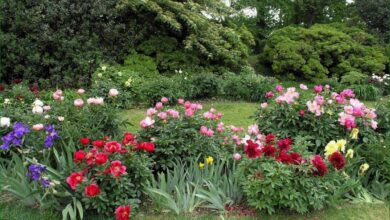
Kalina
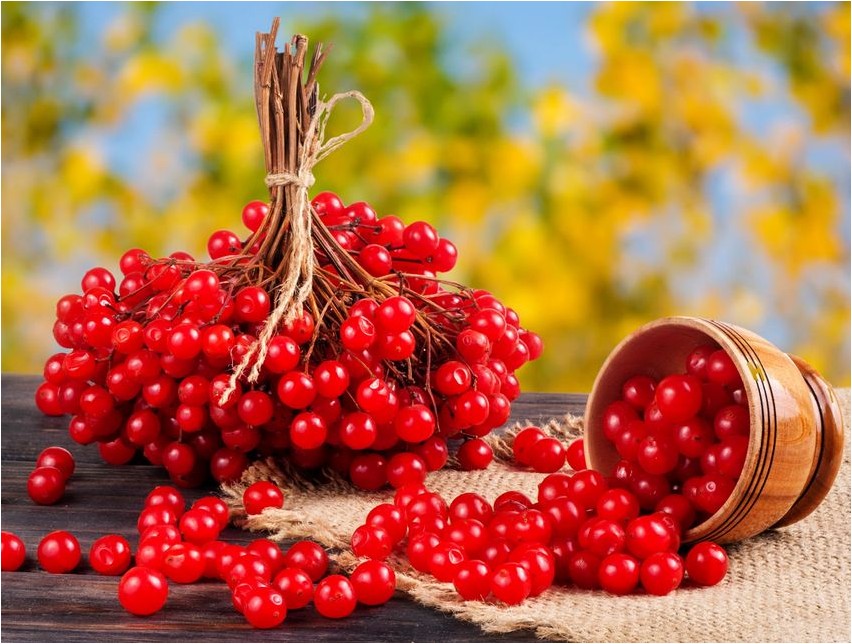
Viburnum (lat. Viburnum) is a berry crop; perennial shrub of the Adoxaceae family. Previously, the genus belonged to the Honeysuckle family.
Under natural conditions, viburnum grows in subtropical and temperate zones of the Northern Hemisphere, North America, Europe and Asia. Currently there are about 150 species.
Characteristics of culture
Viburnum is a deciduous, less often evergreen, shrub or tree up to 4 m high. Winter buds are covered with scales or bare. The leaves are simple, entire, lobed, opposite, sometimes whorled, the edges are serrated, have stipules, located on petioles.
The flowers are white, creamy white or pinkish in color, collected in large racemes. The inflorescence is simple or complex, umbellate or corymbose. The calyx has five small teeth, attached to the ovary. The corolla is bell-shaped or wheel-shaped, with a narrow and elongated tube. The fruit is a drupe, red, black or yellow in color, slightly flattened.
Growing conditions

Viburnum is a light-loving plant; it develops well in open sunny areas, although it produces good yields of berries in the shade. Slopes are suitable for growing plants due to their dense root system. Viburnum prefers moderately moist, deep, fertile soils with a neutral or slightly acidic pH. Some varieties also cope well with highly alkaline soils. It is not advisable to grow the crop on peat, sandy and podzolic soils. Most types of viburnum are highly frost-resistant.
Reproduction and planting
Viburnum is propagated by seeds, green cuttings and layering. Sowing of seeds is carried out in early spring. The seeds are first subjected to long-term stratification. Amateur gardeners extremely rarely use this method of propagation, since seedlings appear only after 1. 5-2 years. The berries of viburnum grown by seed are small and very bitter.
Cuttings are prepared in late June — early July. The cuttings are cut so that at least three nodes remain. The cuttings should be 10-12 cm long. The cut must be at an angle, and the leaves are removed. Before planting the cuttings for rooting, they are treated with growth stimulants, such as “Kornevin.” The cuttings are then planted under plastic or in a greenhouse filled with a soil mixture consisting of garden soil, peat, and well-washed river sand. The optimal temperature for rooting is 27-30°C and humidity 70%. For the winter, the rooted cuttings are covered with sawdust or peat. They are transplanted to a permanent location the following spring. The young plants bloom after 2-3 years. When propagating by layering, low-growing annual shoots are placed in pre-prepared trenches and covered with soil, preferably in early spring. Important: the tip of the shoot should be slightly above ground level; wire can be used to hold it in place. By autumn, roots and buds appear on the layers, which subsequently produce new young shoots. The sprouted layers are then cut from the mother bush and transplanted to a permanent location.
Seedlings are planted in both spring and autumn. Planting holes are prepared in advance; they should be approximately 40-50 cm deep and 50 cm wide. The distance between plants should be 2. 5-3 m, depending on the variety. A third of the hole is filled with a soil substrate consisting of topsoil, humus, peat, and mineral fertilizers (urea, wood ash, and dolomite flour). It is important to remember to apply the ash so that the roots do not come into contact with it. Place the seedlings in a hole, cover with soil, water generously, and mulch with peat. The root collar should be buried a maximum of 4-5 cm.
Care
Viburnum is a moisture-loving plant and requires regular and generous watering for normal growth and development. Water the plants in the evening. Fertilize twice a year: once in early spring before the growing season begins, and again before leaf fall. Urea, potassium sulfide, wood ash, and well-rotted manure or compost are ideal for this purpose. If urgently needed, a small dose of complex mineral fertilizer can be added in the summer.
The plant requires regular weeding and loosening of the soil around the trunk. Sanitary and rejuvenating pruning is equally important for the shrubs, which is carried out in December-January or in the spring when the buds swell. Sanitary pruning involves removing frost-damaged, diseased, and broken branches, while rejuvenating pruning involves removing old branches 20 cm from the ground.
Applications
Viburnum is a highly ornamental plant that fits perfectly into gardens of any style. It is used in group and mixed plantings, to create hedges, and as a solitary specimen. Low-growing varieties are often used in rock gardens and alpine gardens. Viburnum combines beautifully with other coniferous and deciduous shrubs, including maple, linden, birch, rowan, and spruce. The plant retains its decorative appeal in winter, as the berries don”t fall off in the fall and remain hanging until birds peck them.
https://www. youtube. com/watch? v=kV9m2Tlc7D4
Viburnum (Viburnum)