Coltsfoot
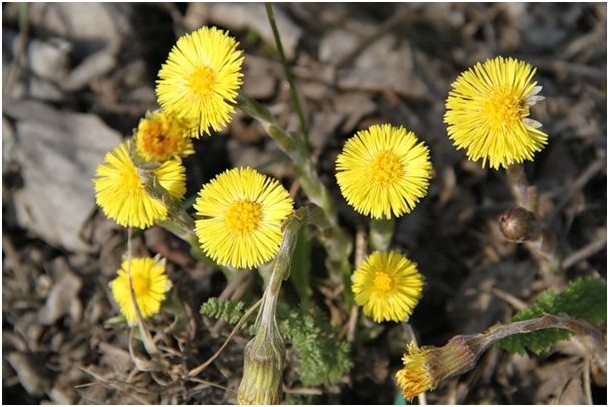
Coltsfoot (lat. Tussilago) is a herbaceous perennial plant of the Asteraceae or Asteraceae family. The monotypic genus is represented by a single plant species – common coltsfoot.
Blooms before the leaves open, in early spring. Since ancient times it has been used as a medicinal plant. A good honey plant.
Description
The roots are branched, creeping, long. The buds on the roots give birth to two types of shoots: vegetative and flowering.
Flower-bearing, low shoots are the first to emerge to the surface. Their surface is covered with scale-like leaves. The flowering shoot ends with a single head, from which flowers of two types of bright yellow color are formed. The outer ligulate, almost thread-like flowers are female. In the middle there are tubular bisexual flowers that do not bear fruit. The fruit is an achene, formed on the marginal flowers and equipped with a parachute (pappus).
On the vegetative shoots, which appear later than the flowering shoots, there are relatively large green leaves. The leaves are petiolate, simple, heart-shaped, irregularly toothed. The leaf venation is marginal and palmate. The upper surface of the leaves is smooth and cold. The lower one, facing the ground, is white felt, soft, warm. The plant owes its name to this leaf structure.

Medicinal properties
Plant cells of coltsfoot leaves secrete mucus, which contains antiseptics and antibodies (immunoglobulins) that can neutralize bacteria and viruses. Since ancient times, colds have been treated with a decoction of coltsfoot leaves; their softening effect eases coughs.
Traditional medicine widely uses coltsfoot in the form of decoctions and infusions. They treat runny nose, flu, allergies, gastrointestinal diseases, and strengthen the nervous system.
The leaves, whole or in the form of a paste, are used for skin diseases and disorders: burns, ulcers, boils, mastitis. To reduce high temperatures, apply the outside of the leaf to the head.
Leaves brewed with boiling water will relieve headaches (one tablespoon of dry leaves per glass of boiling water; take a tablespoon an hour before meals).
In collaboration with other wild herbs, coltsfoot leaves will help:
* for hair and facial skin care (together with nettle);
* it’s better to sweat in a bathhouse (steam coltsfoot leaves, linden blossom, ripe raspberries in a thermos and drink before going to the steam room).
Usage
* For medicinal purposes.
* Blooming in early spring serves as a honey plant. In the spring, when the bulk of plants have not yet awakened, coltsfoot flowers are a source of nectar and pollen for bees.
* The presence of a coltsfoot plant in a garden plot without laboratory tests will indicate that the soil here is slightly acidic.
Contraindications
For pregnant women and nursing mothers, coltsfoot turns its cold side; it is contraindicated for them.
The presence of nitrogen-containing alkaloids in coltsfoot, which are still little studied, limits the duration of one period of use of the plant’s flowers to a month.