Round onion
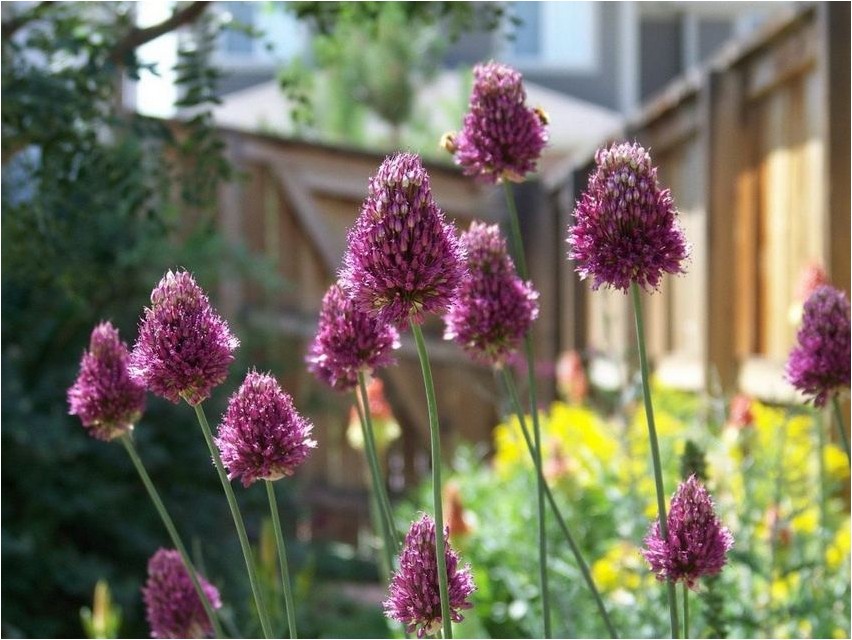
Round-headed onion (lat. Allium sphaerocephalon) is a representative of the Onion genus of the Onion family. A perennial herbaceous plant used in garden landscaping.
Natural range – Western Asia, North Africa and Europe. Typical dreams are steppes, slopes and hills.
Characteristics of culture
Round-headed onion is a plant with an ovoid bulb up to 2 cm in diameter. The bulb shells are whole, leathery, splitting, and brown in color. The stem is covered by one-third with smooth vaginal leaves, up to 80 cm high. The leaves are semi-cylindrical, fistulae, up to 4 mm wide, slightly rough along the edges.
The flowers are collected in box-shaped, spherical or oblong dense umbrellas. The perianth is oblong-ovate, pink or purple, sometimes whitish. The tepals are oblong and sharp. The fruit is an elliptical capsule, rarely notched.
Growing conditions
Round-headed onion is light-loving and is most decorative when grown in sunny areas and southern slopes. Soils are preferably drained, loose, fertile, with a neutral reaction. Acidic soils are pre-limed. An important condition when planting onions is the application of organic and mineral fertilizers, the amount of which depends on soil fertility indicators.
Round onions are sensitive to potassium deficiency, so the content of this element must be maintained at a constant level. Gardeners consider wood ash to be an excellent potassium fertilizer. Humidity for a crop is an equally important indicator, although plants can tolerate short-term drought.

Reproduction and planting
Round onions are propagated by seed and vegetative methods. Seeds are sown before winter or spring. When sowing in autumn, the entrances appear with the onset of stable warmth the following year. Vegetative propagation is carried out using baby bulbs, which are formed at the bottom of the mother bulb. Round onions are divided three years after planting.
Baby bulbs are planted in autumn or spring. The planting depth directly depends on the size of the bulb. Planting is carried out in moistened furrows; the plantings must be mulched with peat or humus. This approach will prevent the formation of soil crust. A crop can grow in one place for many years, but when the planting becomes thicker, the plantings must be thinned out, otherwise the plants will become smaller and bloom worse.
Care
The usual care is loosening the rows, weeding, mulching, watering and fertilizing. With the onset of spring, the mulch is removed and a new layer is applied. Watering is carried out only during drought. Fertilizers are applied in early spring, as well as during budding and bulb formation. At the end of summer, onions are fed with phosphorus-potassium fertilizers. For spring feeding, complex mineral fertilizers with a high content of nitrogen and potassium are used.
Use Round-headed onion is an excellent ornamental crop that can decorate any garden. Plants look great in group and single plantings. Low-growing forms are suitable for forming rocky gardens. Round onions are also used for making bouquets. Moreover, such a composition will last in water for about two weeks. The plant is often used as a spice, as well as in therapeutic and preventive nutrition. Onion leaves and stems have bactericidal and antiscorbutic properties.