Coriander
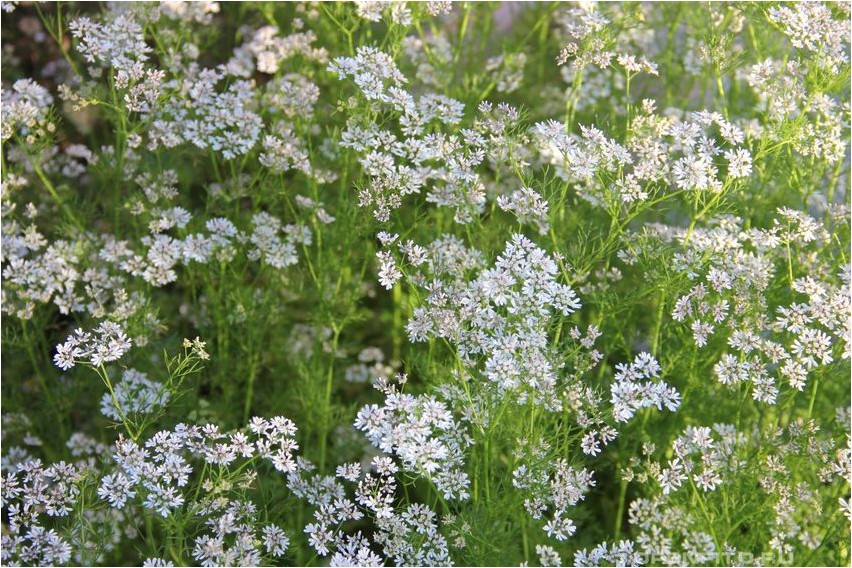
Coriander is a member of the Apiaceae family. Its Latin name is Coriandrum sativum L.
The Latin name for coriander is Apiaceae Lindl.
Description of Coriander
Coriander is also known by common names such as coriander, cilantro, koriandza, and kinze. Coriander is an annual herbaceous plant growing to about twenty to seventy centimeters tall. This plant has a rather thin taproot. Its stems are bare, branched, and erect. The basal leaves are entire, long-petiolate, and trilobate. The lower stem leaves are petiolate, bipinnate, and have ovate, deeply incised lobes. The middle and upper leaves of coriander are sheathed; sessile, they can be either bipinnate or tripinnate, divided into entire and linear lobes. Coriander flowers are collected in compound umbels consisting of three to six rays, and at their ends, smaller umbels containing approximately five to fifteen flowers. It is noteworthy that the umbels lack involucres and the umbels lack involucres. The flowers of this plant are quite small and uneven in size, with the marginal flowers having larger outer lobes. The calyx of coriander is unequally toothed, and the corolla is five-petaled and whitish-pink in color. There are only five stamens, and the ovary is bilocular and has two styles. It is noteworthy that coriander has a rather unpleasant odor. The fruits of this plant are spherical and fused, and can reach up to five millimeters in diameter.
Coriander blooms from June to July. The fruits ripen in August-September. Ripe fruits are yellowish-brown in color, have a sweet-spicy taste, and a rather strong, distinctive aroma. Unripe coriander seeds and fruits have a pleasant aroma. In the wild, this plant is found in the Caucasus, the Baltics, Central Asia, Ukraine, Belarus, European Russia, and the Far East.
Description of the medicinal properties of coriander
Coriander is endowed with very valuable healing properties, and it is recommended to use the fruits of this plant for medicinal purposes. The presence of such valuable healing properties should be explained by the content of essential oil, neocnidilin and Z-ligtolide in the roots of the plant, while flavonoids and essential oil are present in the stems. Coriander sativum leaves contain flavonoids, vitamin C and essential oil. The fruits contain the following beneficial substances: sucrose, glucose, fructose, triterpenoids, essential oil, coumarins, steroids, phenolcarboxylic acids and their derivatives, fatty oil and many others.
As for traditional medicine, here this plant is widely used for stomach diseases and stomach colic, bronchitis, metabolic disorders and neuroses. An ointment based on the fruits of coriander sativum is recommended for topical use for erysipelas, and a decoction based on the fruits of this plant is used as a rather valuable antiemetic, anthelmintic and hemostatic agent. In addition, this decoction is effective for cystitis, diarrhea and neurasthenia, and it is also used for rinsing the mouth during inflammatory processes, for hemorrhoids and as an antiseptic. In addition, the eyes are washed externally with this decoction.

Coriander
https://www. youtube. com/watch? v=m_THCSDLJr4





