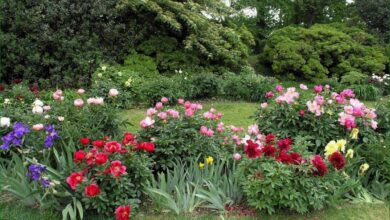
Redbud
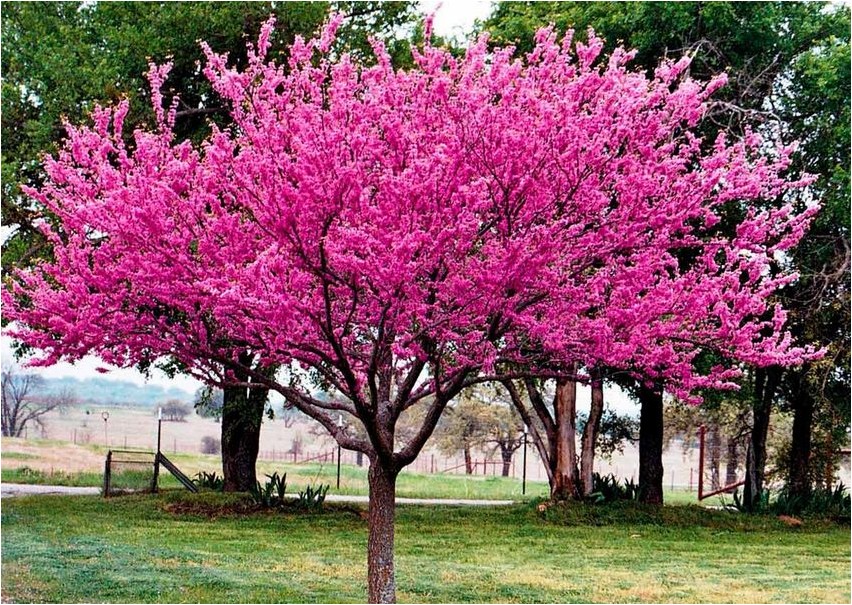
Redbud (Latin: Cercis) is a beautiful flowering plant in the legume family. Its unofficial name is Judas tree. Redbud is also often called the purple rhododendron. The Latin word “cercis” means “weaver”s shuttle.”
Description
Redbuds are beautifully flowering, medium-sized deciduous trees or shrubs with spreading crowns that are often either one-sided or irregularly shaped. Their trunks are covered in black-brown bark, with numerous cracks scattered across the surface. On the twigs, the bark is brownish-grayish, while on young shoots, it is usually smooth and slightly reddish.
Ridden on long petioles, the leaves of redbuds can reach up to ten centimeters in diameter. All of these leaflets are kidney-shaped, alternate, with palmate venation and cordate bases. They are also considered pseudosimplex—the result of the fusion of the upper pairs of leaflets in compound leaves.
The irregular flowers of the red fern are equipped with butterfly-shaped corollas, which are collected in bunches or racemes and are purple or pink in color. These bunches and racemes can form both in the leaf axils and directly on the twigs.
The fruits of the red fern are pods containing four to seven rounded, elongated seeds.
The genus red fern contains six to ten species—the number varies in different sources.

Where it grows
Red fern is most commonly found in the Transcaucasus, the Mediterranean, North America, and a number of regions of Asia, particularly Iran, Afghanistan, Turkmenistan, and the Southern Pamirs. The Eastern Mediterranean is considered the birthplace of this delightful tree.
Use
Cercis will look equally good planted alone or in groups, combined with various conifers, against which the cercis looks simply stunning, especially in spring! These trees also combine beautifully with other plants from the same family, for example, with the concurrently blooming laburnum. Overall, the cercis looks very impressive in all seasons, including winter, when graceful clusters of beans adorn its branches and trunks.
In southern regions, cercis makes a magnificent ornamental hedge. Furthermore, this plant is often planted along paths.
Cultivation and Care
All varieties of red fern are very heat-loving, so they should be grown in full sun, in well-drained, lime-rich soil. This beauty thrives especially well on the south side of houses or on south-facing hillsides. However, the site should be well protected from drafts! Red fern should also be avoided near rapidly growing or overly large plants, as over time, the larger plants will begin to actively suppress it.
Water red fern only during dry weather, and then only as needed, as this plant is quite drought-tolerant. Fertilize with organic fertilizer only once a year, ideally in May.
Red fern is propagated primarily by seed, but its seedlings develop very slowly. Importantly, young plants require adequate winter insulation. In addition, in some cases they require formative pruning—it is recommended to trim only those young shoots that in no way contribute to the proper formation of the crown. As for mature branches, they are not pruned unless absolutely necessary.