Ruscus
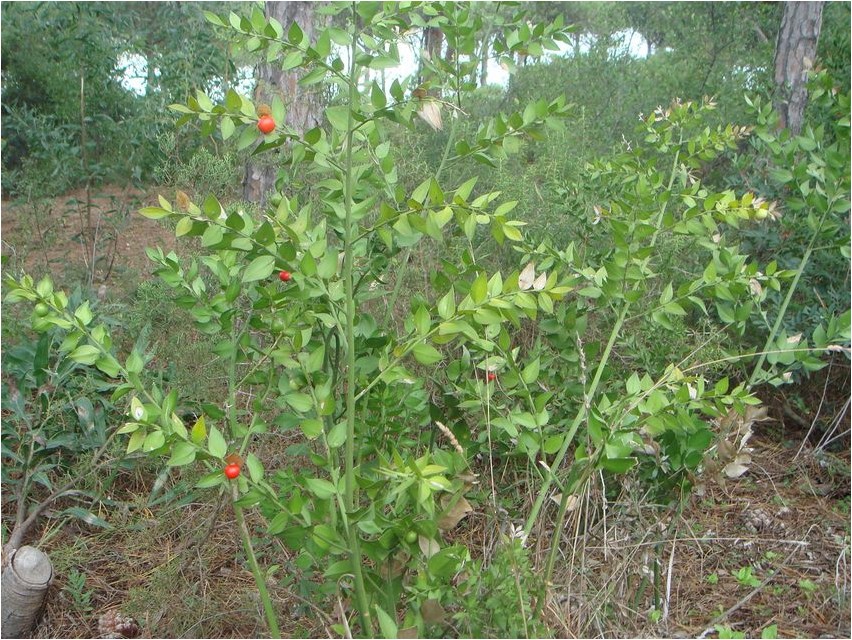
Ruccus (Latin: Ruscus) is a small genus of undemanding subshrubs, comprising only six species. They attract attention with the unusual appearance of their branches, which resemble familiar plant leaves.
The true leaves, however, are small, awl-shaped scales. Ruscus flowers are inconspicuous, but after pollination, they manage to turn into brightly colored berries.
What”s in a name?
Latin names for plants are often based on Greek words. Ruscus, or Ruscus in Latin, deviates from the norm, being based on an Anglo-Saxon word that sounds like “box” in Russian. The Russian name “Iglitsa,” given to the plant for its awl-shaped leaflets, has a competitor, the “Mouse Blackthorn,” for the small size of the flowers emerging from the axils of these prickly scales.
It should be noted that the genus “Ruscus” (or Iglitsa) was not immediately included in the Asparagus family, but was initially classified in the Liliaceae family.
Description
This evergreen shrub has an unusual stem, which, at a glance, can be mistaken for plant leaves. Botanists call such stems “cladodes” or “flat branches.”
Upon closer inspection, true leaves, shaped like awl-shaped scales, are revealed on the surface or along the edges of these leaf-like stems. It is in these axils that small white flowers with dark purple centers appear. Because the scales are very small, the flowers appear to emerge directly from the flat stems.

After pollination, fleshy red berries up to one centimeter in size appear in the place of the female flowers. The berries of one species in the genus are edible.
Varieties
* Butcher”s broom (Latin: Ruscus aculeatus) is an evergreen shrub native to Crimea and the Krasnodar Territory. Small, oval cladodes with spiny tips grow on erect, branched stems. Greenish flowers emerge from the surface of the cladodes, which turn into fleshy red berries by late autumn. The branches of the shrub are used to make brooms, hence the plant”s other nicknames: “Butcher”s broom” or “Executioner”s broom.” * Ruscus hypophyllum or butcher”s broom (lat. Ruscus hypophyllum) — this species is not protected by thorns, and therefore its cladodes are used for cutting into bouquets.
* Butcher”s broom (lat. Ruscus hypoglossum) — cladodes of this species are not armed with spines. Small red berries replace the greenish-yellow inconspicuous flowers that appear in the world in the spring. Shade-tolerant species.
* Butcher”s broom microglossum (lat. Ruscus x microglossum) is a root shoot plant with erect or ascending stems. It is a hybrid of the two previous species.
* Butcher”s broom (lat. Ruscus racemosus) is a branched shrub with short curved stems. Small green cladodes with orange-red berries on their glossy surface complement flower bouquets well.
Growing
Ruscus prefers heat, but can withstand frosts of at least 20 degrees. Therefore, in areas with harsher winters, the plant is grown as a houseplant. But Iglitsa hypophyllum (Ruscus hypophyllum) does not like any frost; give it only a warm climate.
For a plant, the composition of the soil is not as important as its moisture content. This applies only to the first years of life. As shrubs mature, they tend to have dry soil. Excessive dampness causes fungal diseases of the roots. In addition to insidious fungi, the weevil weevil along with its offspring, the larvae, is dangerous for the plant.
The location for Iglitsa is suitable both sunny and shaded.
Reproduction
Sowing of seeds is carried out in the fall, planting in a prepared place in open ground in the spring. You can also propagate in spring by dividing the overgrown bush. Before planting, the soil is fertilized with organic matter.
The seedlings are watered in the spring, adding mineral fertilizer to the water once a month.
Iglitsa
Iglitsa Iglitsa