Serratula cardunculus
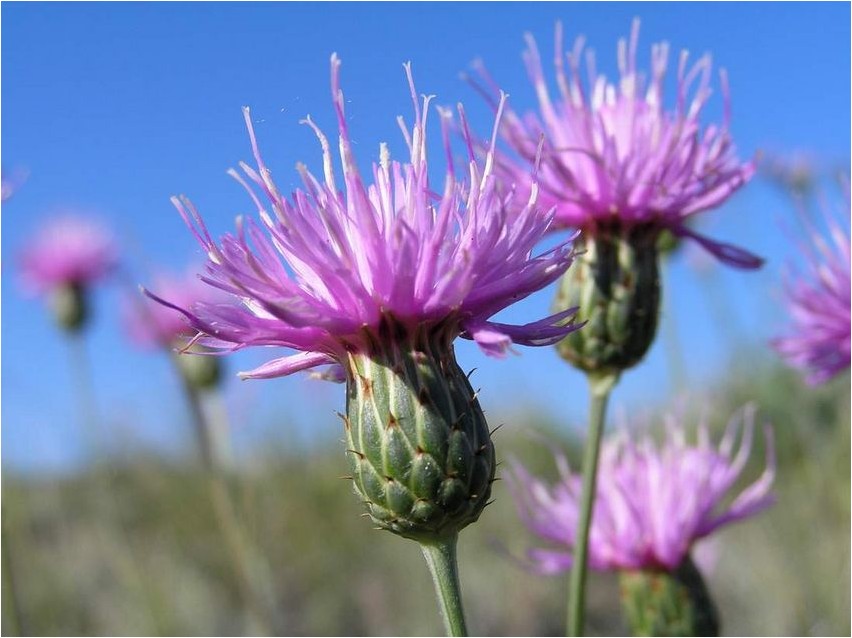
Serratula cardunculus is a member of the Asteraceae or Compositae family. Its Latin name is Serratula cardunculus (Pall.) Schich. (S. nitida Fisch. ex Spreng.).
As for the family name of Serratula cardunculus, the Latin name is Asteraceae Dumort. (Compositae Giseke).
Description of Serratula cardunculus
Serratula cardunculus is a perennial herbaceous plant, reaching a height of between twenty and fifty centimeters. Its rhizome is quite robust and short, bearing numerous cord-like roots. The stems of Serratula cardunculus are straight, grooved, and simple, though rarely they may be branched at the top. The basal leaves of this plant are elliptical and borne on long petioles. These leaves are approximately five to twenty centimeters long and one to five centimeters wide. These leaves can be either short-pointed or obtuse, and their undersides are glaucous. The stem leaves of the thistle-leaved serratula are smaller and sessile. The flower heads of this plant are borne on elongated peduncles, with approximately two to seven flower heads, located on the lateral branches of the stem. Interestingly, these head heads can sometimes be solitary. The corolla of the thistle-leaved serratula is pale, approximately fifteen millimeters long, and colored in lilac-pink tones. The corolla, in turn, has a thin tube, four to five millimeters long, and the achenes are approximately nine millimeters long. The achenes of this plant are brownish in color, and the pappus is eight to nine millimeters long.
The flowering period of the thistle serratula begins in May and ends in June. In the wild, this plant is found in Central Asia, as well as in the following regions of European Russia: the Trans-Volga, Upper Volga, Lower Don, Volga-Kama, and Lower Volga regions. This plant prefers desert steppes, the banks of alkaline mountains, fallow lands, and steppe and alkaline meadows.
Description of the medicinal properties of the thistle serratula
Serratula thistle possesses valuable medicinal properties, and its inflorescences and herb are recommended for medicinal purposes. The term “herb” includes the leaves, stems, and flowers.
In Tibetan medicine, this plant is quite widespread. Infusions and decoctions prepared from Serratula thistle are recommended as highly effective wound-healing and hemostatic agents. For scrofula, an infusion of this plant’s inflorescences should be used as a bath. It is noteworthy that in the Urals, a decoction of Serratula thistle is used as an analgesic.

The following remedy is recommended as an analgesic: to prepare this remedy, take one tablespoon of Serratula thistle per one glass of water. The resulting medicinal mixture should first be boiled for three to four minutes, then left to steep for about two hours and then strained very thoroughly. Take one to two tablespoons of thistle-based herb three times a day, regardless of meals. When used correctly, this remedy is very effective.





