Ludisia

Ludisia (lat. Ludisia) – indoor plant; perennial herbaceous plant of the Orchidaceae family. It is native to Southeast Asia and Indonesia.
Under natural conditions, ludisia grows in the southern regions of China, Thailand, Vietnam, Malaysia and Sumatra. In floriculture, this plant is classified as a “precious orchid”; their beauty lies not in the flowers, but in the color of the leaves.
Characteristics of culture
Ludisia is an evergreen plant no more than 15 cm high. The stems are creeping, forming the shape of a miniature bush. The leaves are alternate, velvety, purple or olive in color with light veins or iridescent silver strokes or stripes, 7 cm long, 3-4 cm wide, collected in rosettes.
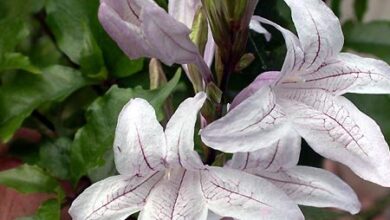
The rhizome is red, very thick, highly branched. The flowers are small, yellowish-white or white, arranged alternately on peduncles, the length of which is about 30 cm. 20-30 flowers grow on one peduncle.
Ludisia variegated, subspecies

Ludisia discolor (lat. Ludisia discolor) – the species is represented by a creeping plant with fleshy shoots ending in a short leafy area containing 3-6 dark green leaves with bright thin veins. The flowers are small, white, slightly slanted to the side on one side. Inflorescences are apical, 15-20 cm long.
Ludisia variegated is represented by several subspecies:
*Ludisia versicolor syn. ordiana – dark green leaves with golden or silver veins.
*Ludisia variegated var. condorensis – rather large leaves, long peduncles.
*Ludisia variegated var. dawsoniana – leaves are large, green with a black tint and red veins.
*Ludisia variegated var. otletae – lanceolate-shaped leaves, dark green with red veins located only on the lobar vein.
*Ludisia variegated var. rubrovenia – leaves are elliptical, bronze with copper-colored veins.
Growing conditions
Ludisia is a shade-loving plant, prefers rooms with diffused light, and has a negative attitude towards direct sunlight. It also grows well under artificial light. When there is an excess of sunlight, plants droop and lose their decorative properties, and when there is not enough sunlight, they become very elongated.
The optimal temperature for keeping ludisium is 20-22C, the minimum limit is 18C. It is desirable that the difference between night and day temperatures be about 2-3C. The culture is neutral to dry air, but requires regular spraying with warm and settled water. Hard water should not be used for these purposes, as it leaves behind salt stains.
During the period of active growth, ludisia leaves need to be doused with warm water, after which the plants are blotted with a paper or cloth napkin.
Reproduction, planting and transplanting
Ludisia is propagated by apical cuttings, dividing the bush and stem segments. The apical cuttings are separated with 3-4 nodes on the stem, aerial roots and dormant buds, the sections are sprinkled with charcoal and dried. The cuttings are rooted in special moderately moist sphagnum moss and buried to the base of the leaf. Rooting in water with dissolved activated carbon is also not prohibited.
Quite often, Ludisia is propagated by leafless stem segments. The cut stem should have several internodes. Root the stem segments in moist sphagnum, inserting them horizontally without deepening them.
Frequent replanting of plants should not be carried out, only in the case when the ludisias grow greatly and the pots become too cramped. It is advisable to replant in the spring. Pots need to be wide and shallow.
As a substrate, you can use either ordinary garden soil or a mixture with a high proportion of humus and peat. A suitable substrate consists of leaf soil, fern roots, peat, pine bark and charcoal. A larger fraction of the substrate must be placed at the bottom of the pot, and fresh sphagnum can be placed on its surface.
Care
The abundance and frequency of watering depends on the temperature of the ludisia content, and the higher it is, the more watering should be. It is recommended to ensure that water does not stagnate in the pot or accumulate in the tray, as this can lead to rotting of the roots. Water the plants when the soil substrate is thoroughly dry. Ludisias are fed with complex mineral fertilizers only during the period of active growth and flowering.