Marsh geranium
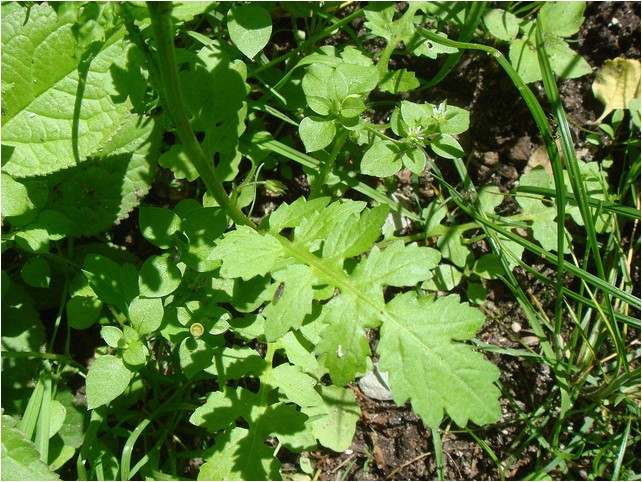
The marsh geranium is one of the plants of the family called cruciferous; in Latin the name of this plant will be as follows: Rorippa palustris (L.) Bess.
As for the name of the marsh iron family itself, in Latin it will be: Brassicaceae Burnett.
Description of the marsh zherushnik
The marsh geranium is a perennial herbaceous plant, the height of which will fluctuate between ten and one hundred centimeters. The plant is endowed with sparse hairs along the very petioles of the leaves, the stem is straight or ascending, and is also mostly branched. The leaves of the marsh zherushnik are either dissected or lyre-pinnate. The flowers are quite small in size and colored in light yellow tones. The pods of this plant are oblong, slightly curved and can sometimes be almost completely spherical. The length of such pods will be about three to eight millimeters, and the width will be two to three millimeters. The flowers of this plant are at the top with a short style, the length of the seeds will not exceed a centimeter, and the width will be about half a millimeter.
The flowering of the marsh zherushnik occurs during the period from June to August. Under natural conditions, the plant is found in the Arctic regions of Russia, as well as in the European part of Russia, the Far East, Western and Eastern Siberia, Ukraine, the Caucasus, Central Asia, Moldova and Belarus. The plant prefers places to grow along the banks of swamps, lakes and rivers, as well as sandy places and saline meadows. This plant can also grow as a weed in gardens.
Description of the medicinal properties of marsh zherushnik
The marsh geranium is endowed with very valuable healing properties, and it is recommended to use the seeds, roots and grass of this plant for medicinal purposes. The concept of grass includes flowers, leaves and stems.
The presence of such valuable healing properties is due to the content of flavonoids, vitamin C, saponins, alkaloids, quercetin, kaempferol diglycoside and biosides in this plant. The leaves contain vitamin C, and the seeds contain fatty oil.

In ancient times, the roots were used as a blood purifying drink. The herb is used as an antiscorbutic, diuretic and blood purifier for various liver diseases, blood stagnation, kidney diseases, bladder and stomach diseases. The herb can also be applied to burns. A decoction of marsh zherushnik seeds is used as an anthelmintic, and also as a substitute for mustard plasters.
As for traditional medicine, a decoction of the herb of this plant is used for headaches, pulmonary tuberculosis and trichinosis. In veterinary medicine, the herb of this plant is used as a disinfectant for smallpox in sheep. Young plants can be eaten as salad.
For cystitis, it is recommended to prepare the following remedy based on the marsh clam: to prepare such a remedy you will need to take two tablespoons of dry crushed herb per half liter of water. The resulting mixture should be boiled for three to four minutes, and then left to infuse for two hours, after which the product is filtered very carefully. Take the resulting product one third of a glass three times a day before meals. It is worth noting that in order to achieve the greatest effectiveness, it is recommended to follow not only all the standards for the preparation of this product, but also strictly follow all the rules for its administration.
It is noteworthy that this plant is always characterized by great effectiveness when used.





