Makodes
Makodes (lat. Macodes) – indoor plant; plant of the Orchidaceae family. Under natural conditions, makodes grows in the tropical rainforests of the Malay Archipelago, New Guinea, the Philippines and Oceania.
The plant got its name from the structural features of the lip on the flower.
Characteristics of culture
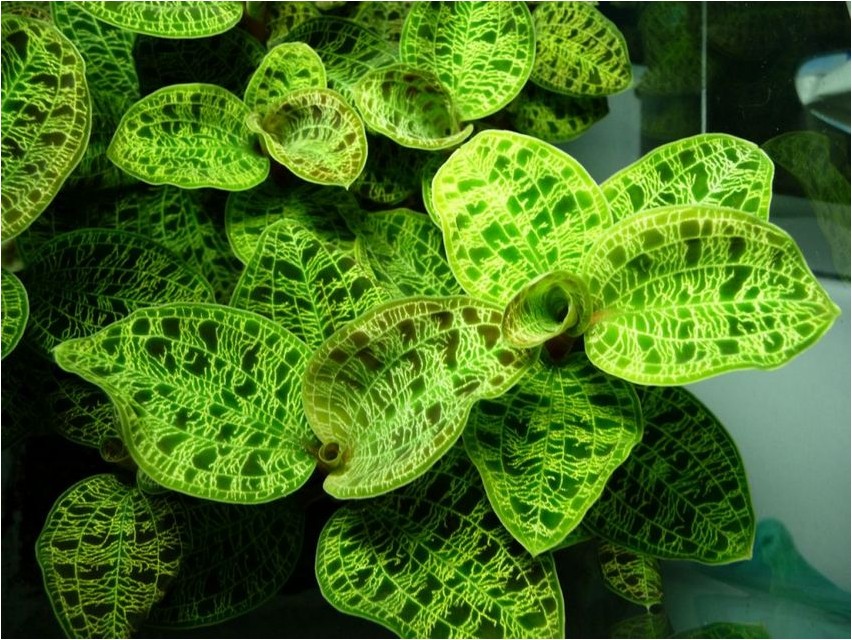
Makodes is an epiphytic or terrestrial plant with a sympodial growth pattern. Part of the group of precious orchids. Makodes are valued for the special decorativeness of their leaves, velvety over the entire surface and covered with a beautiful pattern of sparkling veins of various colors. The veins can be gold, silver, bronze or copper in color, and the leaves can be green, olive, black-green or brown. The flowers are small, located on short peduncles.
Macodes petola is most often grown indoors. This species has fleshy shoots, velvety leaves of emerald green color with bright golden veins. Peduncles reach a length of 7-8 cm. The flowers are small, red-brown, with a white lip directed upward, collected in erect racemes.
Conditions of detention

Makodes prefers rooms with diffused light, has a negative attitude towards direct sunlight, needs shading, otherwise the leaves get severely burned, turn yellow and fall off. In winter, plants require additional illumination with fluorescent lamps. The optimal temperature for normal development is 22-25C during the day, 18C at night. At temperatures below 18C the leaves take on a burgundy hue.
Air humidity is an equally important factor for the growth of makodes; it should be 80-90%. With low humidity, plants develop more slowly, leaves lose their attractive color, and their tips begin to dry out. In this case, plants can be saved by regular spraying with soft water from a spray bottle. Hard water is not suitable for these purposes, as salt stains appear on the leaves.
Reproduction and planting
The crop is propagated by cuttings and division of rhizomes. Apical cuttings can be taken throughout the growing season, although this procedure should not be carried out during the dormant period. Cuttings of the cuttings are powdered with crushed activated charcoal or charcoal, then the planting material is buried at the base of the leaf in moist sphagnum. Makodes are often propagated by leafless stem segments, which are placed horizontally in the substrate.
Transfer
Repotting of macodes is carried out in the spring or immediately after flowering, but as needed, once the plant roots have firmly established themselves in the substrate. Use shallow, spacious containers with a nutritious and moisture-retentive substrate, which can be purchased at a store or made yourself.
A mixture of chopped fern roots, leaf mold, peat, charcoal, and pine bark pieces is ideal. Place the coarser portion of the substrate at the bottom of the pot, and the finer portion closer to the surface. The surface can be covered with sphagnum moss; this will not harm the plants. Immediately after repotting, move the plants to a warm, well-lit room with high humidity.
Care
Macodes require regular and abundant watering throughout the year. Avoid stagnant water in the pots, as this will adversely affect the plant’s root system. For macodes orchids, bottom watering is recommended; avoid watering the leaves, much less their axils. Avoid watering plants in rooms with temperatures below 17°C (63°F), as their roots cannot absorb the water and will rot.
During the active growth period, give the plants a warm shower, keeping the water temperature around 35°C (95°F). After the shower, blot the macodes orchid leaves with paper towels before bringing them indoors. If the plants lack sufficient light in the fall and winter, they enter a dormant phase, typically from October to February.
Fertilize only during the active growth period, using special mineral fertilizers for orchids. Fertilize no more than once a month; overfeeding will cause the plants to lose their decorative appearance.