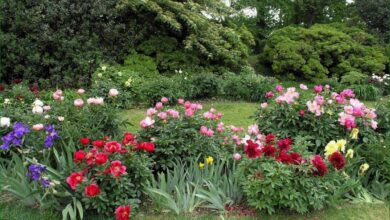
Redbud

Redbud (Latin: Cercidiphyllum) is a genus of deciduous shrubs and trees in the monotypic family Redbudaceae, or Cercidiphyllum, belonging to the order Saxifrage.
Also known as Cercidiphyllum, the plant is widespread in China, Japan, and on Kunashir Island.
Cultural Characteristics
Redbud is a deciduous shrub or tree with a distinctive crown up to 30 meters tall. The bark is dark gray and fissured. Young shoots are brown and glabrous, while the remaining shoots are grayish-brown. The leaves are opposite, broadly ovate, elliptical, or triangular, with crenate-serrate margins and palmate-loop venation. The upper surface of the leaf is bluish-green, while the lower surface is glaucous, often with reddish veins. Young leaves have a beautiful purple-pink color with a satin sheen. The flowers are small, wind-pollinated, unisexual, perianthless, and borne in reduced, compacted racemes. The fruit is a multi-seeded, single-leaflet, tap-shaped. The seeds are winged.
Growing Conditions
Crimea cerasus prefers well-lit areas, though light shade is acceptable. Young plants react negatively to direct sunlight, as there is a high risk of bark burn. Soils should be slightly acidic, fertile, well-drained, calcareous, and moderately moist. The optimal soil pH is 5. 5-6. The minimum groundwater level should be at least 2 meters, as crassula cerasus does not tolerate waterlogging. The plant can also thrive in acidic or alkaline soils without any problems; in the former, the foliage of crassula cerasus acquires a more intense color, especially in the fall. South-facing slopes, as well as the south side of buildings and structures protected from northerly winds, are most suitable for growing redbud.

Propagation and planting
Crimson is propagated by seeds and cuttings. The seed method is not effective; often the seeds do not germinate. Seeds are sown in the fall, immediately after harvest. Crops are mulched with a thick layer of pine needles or dry healthy foliage. Shoots appear in spring. When 3-4 true leaves appear on the seedlings, they are transplanted to a permanent place. Propagation by cuttings is a more common method. The technique for cutting scarlet grass is practically no different from the similar technique for other shrubs and trees. Cuttings 12-15 cm long with two internodes are cut in late June — early July. The cuttings are rooted in summer greenhouses at a temperature not lower than 22-25C. Planting in open ground is carried out at an angle in the fall, but two months before the onset of stable frosts. Often the above-ground part of young plants freezes in winter, but in spring new, stronger and stronger shoots are formed.
Care
Young shrubs are very sensitive to drought, so they need systematic watering. It is undesirable to allow the soil in the tree trunk area to dry out. In spring and summer, crimson is fed with nitrogen (10 g per 1 sq. m), phosphorus (15 g per 1 sq. m) and potassium fertilizers (20 g per 1 sq. m). The application of complex fertilizers is not prohibited. Weeding and loosening are also necessary for the normal development of the crop. In early spring, preventative pruning is carried out: frostbitten, weak and broken branches are removed.
Application
Unfortunately, crimson trees are extremely rare in Russia and European countries. This is due to the lack of information about growing crops. Scarlet seedlings are not sold in all nurseries, but there is hope that soon the unpretentious plant will become one of the favorite shrubs and trees of Russian and foreign gardeners. Crimson plants look great in single plantings, as well as in a group with conifers. In the southern regions, the crop is used to create decorative hedges.