Chayote
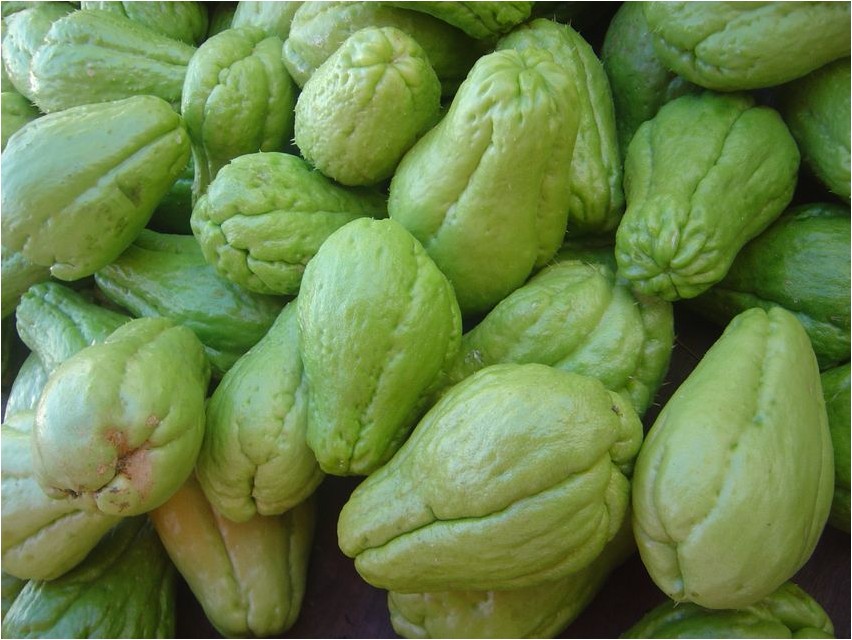
Chayote (lat. Sechium) is a herbaceous plant of the Cucurbitaceae family. Another name is Mexican cucumber. Central America is considered to be the birthplace of the plant.
Chayote has been cultivated since ancient times. Today, Costa Rica is the main supplier of chayote. Translated from the Aztec language, the word “chayotli” means “pumpkin covered with thorns”, and in fact, the plant tastes like both pumpkin and cucumber.
Characteristics of culture
Chayote is a perennial climbing plant, the shoots of which reach a length of 20 m. The shoots are equipped with longitudinal grooves, slightly pubescent over the entire surface, and cling to the support with tendrils. During active growth, the culture forms up to 8-10 root nodules weighing up to 10 kg. Depending on the variety, the tubers can be green, light green, yellow or white. The tuber pulp is always white, similar in texture to potato pulp.
The leaves are wide, round, with a heart-shaped base, 10-25 cm long, pubescent with stiff hairs, and have 3-7 obtuse lobes. The flowers are greenish or cream, unisexual. The corolla is small, with a diameter of 1 cm (no more). Male flowers are collected in racemes, female flowers are single. The fruit is a round or pear-shaped berry 7-20 cm long with a thin, durable and shiny skin, often with growths or longitudinal grooves. The weight of the fruit varies from 100 g to 1 kg. One fruit contains one large flat-oval seed.
Growing conditions
Chayote is not picky about soil conditions and can grow normally on any soil, even poor soil, but it produces large yields only on light, loamy, chernozem or peaty, well-drained soils. Chayote responds positively to well-fertilized areas. The culture does NOT accept saline, heavy, compacted and acidic soils. Chayote is a light-loving plant, and it is preferable to grow it in sunny areas. Light openwork penumbra is not forbidden.
Landing
The planting material is the whole chayote fruit. The seed should not be removed from the fruit, as it loses its viability. The fruits are planted in an inclined position with the wide part downwards in mid-March in greenhouses or in seedling containers under film. The upper tip of the fruit should remain uncovered by the soil substrate. After planting, the soil is thoroughly watered with warm water. The first shoots of fruit appear in 5-7 days. Chayote grows quite quickly, forming a huge number of shoots. For this reason, the crop is grown using a trellis method with systematic pruning of non-fruiting shoots.

In central Russia, chayote is grown only in greenhouses or greenhouses, often in pots as a houseplant. You can buy chayote fruits in stores and markets in the fall. In order to preserve them until spring, they are laid out in a room with a temperature of no more than 5-10C. The area for growing chayote is prepared in advance: the soil is dug up, filled with organic and mineral fertilizers, for example, rotted manure and nitrophoska. The support on which the stem will curl is also prepared in advance.
Care
Chayote care consists of watering, loosening and fertilizing. It is important to regularly water the plants with warm and settled water; the soil in the stem zone should not be allowed to dry out. The use of cold water threatens the appearance of rot of various types. Fertilizing is carried out 2-3 times per season; a solution of mullein with the addition of mineral fertilizers is ideal for this purpose. When the plant reaches a height of 70-80 cm, the lashes are pinched, leaving 2-3 healthy and strong shoots.
Harvesting and storage
Chayote is a short-day plant, but regardless of this, flowering occurs only in September. The fruits can remain on the shoots until the first frost. The fruit yield from one plant can be about 60-80 fruits. At a temperature of 5-10C, the fruits are stored well, without losing their quality until spring. In the second year, you can get up to 300 fruits from the plant. Young shoots are also used for food.