Ceanothus
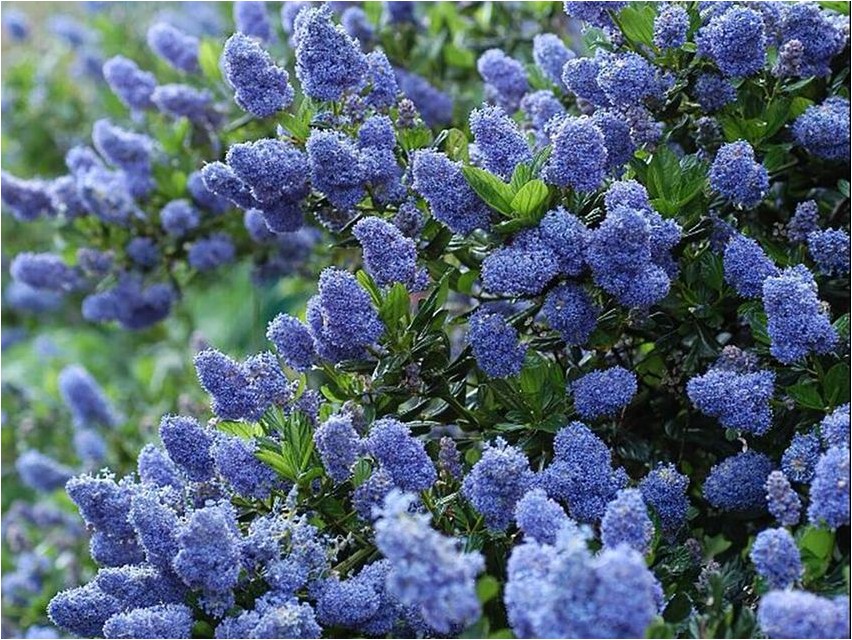
Ceanothus (lat. Ceanothus) is a genus of beautifully flowering ornamental shrubs of the buckthorn family. Another name is redroot (this is due to the content of red dye in the roots of plants).
The genus contains about 80 species, distributed mainly in North America.
Characteristics of the culture Ceanothus is a deciduous or evergreen shrub, less often a tree. The leaves are simple, ovate or elliptic, serrated along the edges or petiolate, opposite or alternate, equipped with deciduous stipules. The flowers are small, bisexual, white, blue, pink or red, collected in lush paniculate inflorescences. The corolla is five-membered. The fruit is round in shape, dry, and when ripe, splits into three lobes. In Russia, the most popular species is American ceanothus; in America it is called California lilac. American ceanothus is grown in gardens and parks, as well as on personal plots. It is distinguished by increased cold-resistant properties compared to its relatives.
Growing conditions
Ceanothus is a delicate and capricious plant; for normal development it is recommended to grow it in sunny areas protected from cold, piercing winds. Soils are desirable to be well-drained, fertile, and moderately moist. You can grow the crop in close proximity to the walls of houses and high fences, but with the condition that there will be shadow on only one side.
Reproduction and planting
Ceanothus are propagated by seeds, cuttings, layering and dividing the bush. Seeds are sown immediately after collection under cover in the form of peat or sawdust. When sowing in spring, seeds require preliminary stratification at a temperature of 1-5C for 3 months. Before stratification, the seeds must be treated with a gibberellin solution, then dried and soaked for several minutes with a 3% thiour solution. The seed placement depth is 0. 5-0. 7 cm. The first shoots appear after 65-70 days. With proper processing, up to 70% of the seeds are included.
Cuttings of the crop are carried out in the summer. Root the cuttings in a light and loose substrate under a plastic film or cap. For the winter, the rooted cuttings are transplanted into pots and grown indoors, and in the spring, the formed plants are planted in a permanent place. The crop is propagated by layering in spring or summer; the lower shoots are bent to the soil surface, pinned and covered. It is important to provide the layering with regular moisture. Rooted cuttings are transplanted next spring.

Care
Ceanothus care involves regular and abundant watering, mulching the trunk area in winter to preserve the root system, and sanitary pruning to remove dry, frost-damaged, and thickening branches. Without cover, plants can freeze completely.
Uses
The plants are used in garden design: as solitary specimens against shrub groups and mixed borders. Ceanothus inflorescences of white, light blue, blue, and pink colors look harmonious against a backdrop of dense greenery. Ceanothus are suitable for growing in containers.
A yellow-brown dye is produced from the above-ground parts of the plants, and a green dye is produced from the flowers. The resulting dyes are used to dye fabrics. Some Ceanothus species are used to prepare medicinal remedies for ailments, skin diseases, respiratory inflammations, and other ailments. The leaves of the velvety ceanothus are brewed into a refreshing and aromatic drink.