Pueraria nodule
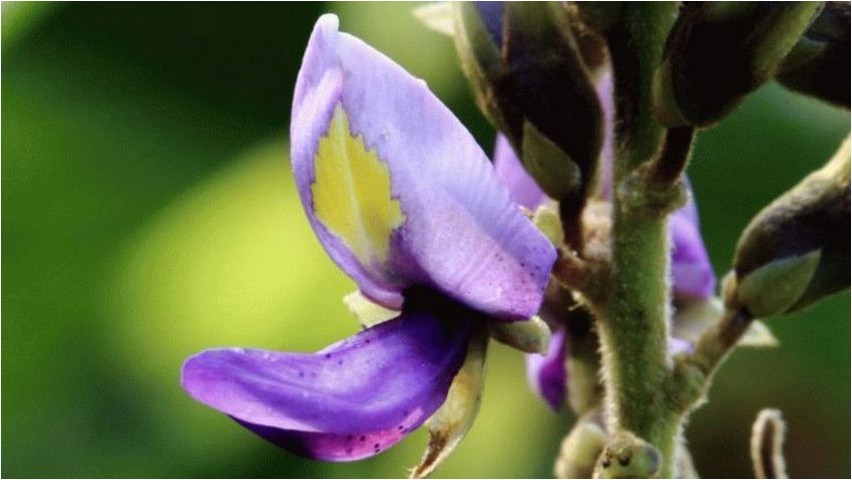
Pueraria tuberosa (lat. Pueraria tuberosa) is one of the liana-like plants of the genus Pueraria (lat. Pueraria) of the legume family (lat. Fabaceae).
The plant is distinguished not only by its fast-growing woody stem, but also by its large underground tubers of the root system, rich in starch, water and sweet in taste. The popularity of tubers among people has become a tragedy for the plant, which is slowly but surely disappearing from the Earth, and therefore needs protection.
What’s in your name
If the Latin name of the genus “Pueraria” in no way characterizes either the external or internal properties of plants, but only preserves the memory of the Swiss botany with the same name – Marc Nicolas Puerari (1766 – 1845), then the specific epithet “Tuberosa” indicates the shape of the root system, on the filamentous roots of which large tubers of the most diverse, sometimes bizarre, shapes are formed.
But the popularity of Pueraria nodule tubers has been earned not by their simple or bizarre forms, but by their internal rich content of substances useful to the human body.
All species of the genus “Pueraria” differ from each other in very subtle morphological characters, which only specialists can recognize. Therefore, plants of the genus have a common name, which most often refers to completely different species. This name is Kudzu.
Description
The main part of Pueraria nodule is its roots, on which fairly large tubers are formed, reaching a length or width of 25 centimeters. The shape of the tubers likes to surprise amateurs, either taking on a spherical shape, familiar to other tuber-vegetable crops (turnips, beets, radishes…), or becoming similar to an ancient handmade clay pot. Inside the tuber there is a white starchy mass that tastes slightly sweet.

The roots reveal a woody tuberculate stem into the world, which, like other species of the genus, grows quickly, rising to a height of up to 20 meters, if it encounters a suitable stable support in the form of powerful tall trees along the way, or spreads along the surface of the earth, simultaneously covering the soil with its large leaves from weather surprises.
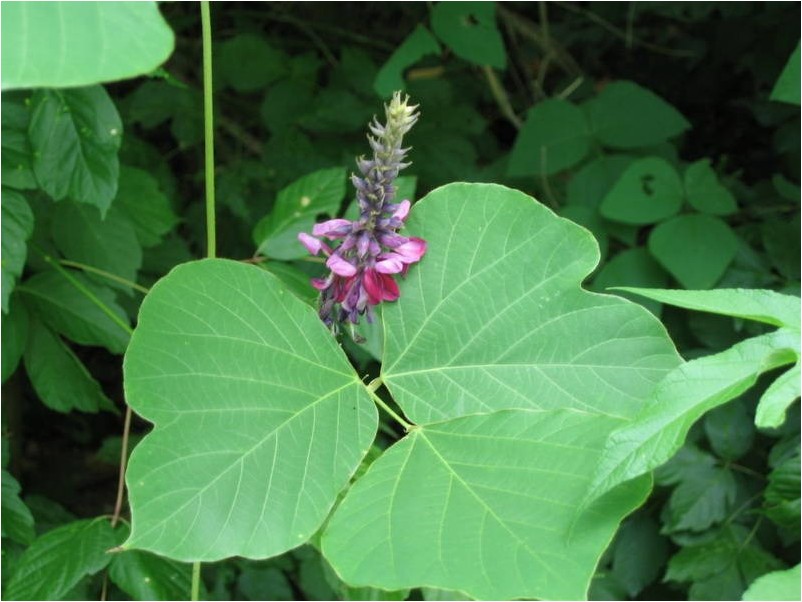
Large compound leaves are arranged on the stem in a regular order and are formed by three simple ovoid leaves. The leaves have a round base, unequal sides and numerous veins. The lateral veins, starting from the main midrib, fan out to the edge of the leaf blade, dividing the surface of the plate into almost even, parallel stripes and giving the leaves, which are simple at first glance, a certain decorative charm. The leaflets reach 18 centimeters in length and 16 centimeters in width.
Flowers characteristic of plants of the legume family, about 1. 5 centimeters in diameter, are bisexual. The petals are colored blue or blue-violet.
The fruit is a linear bean pod, 2 to 5 centimeters long. A pod can contain from 3 to 6 seeds, which are separated from each other by tightly packed pod tissues. The surface of the pod valves is covered with reddish-brown hairs, silky or bristly.
Pueraria nodule is native to Southeast Asia (Pakistan, India, Nepal).
Usage
Tubers of the described type are very highly valued by pharmaceutical and Ayurvedic companies, who are willing to pay up to 100 thousand rupees for a red variety tuber weighing about 10 kilograms (today it is approximately 130 thousand rubles). This attitude towards tubers is associated with the gradual disappearance of plants in the wild. Moreover, illegal tuber hunters do not even always dig up the tubers, but draw out their contents with syringes, leaving the plants without nutrients, thereby dooming them to death.
The healing abilities of the plant tubers are equated to the “elixir of youth.” Preparations made from them have a rejuvenating effect on the human body, beneficially affecting the circulatory system, lowering blood pressure, and regulating the amount of sugar in the blood.
Although tubers were used by Chinese doctors as far back as 5 centuries BC, today, when the world has become so open and cramped, and diseases are becoming more insidious, interest in the healing abilities of tubers has become especially high.





