Japanese alder
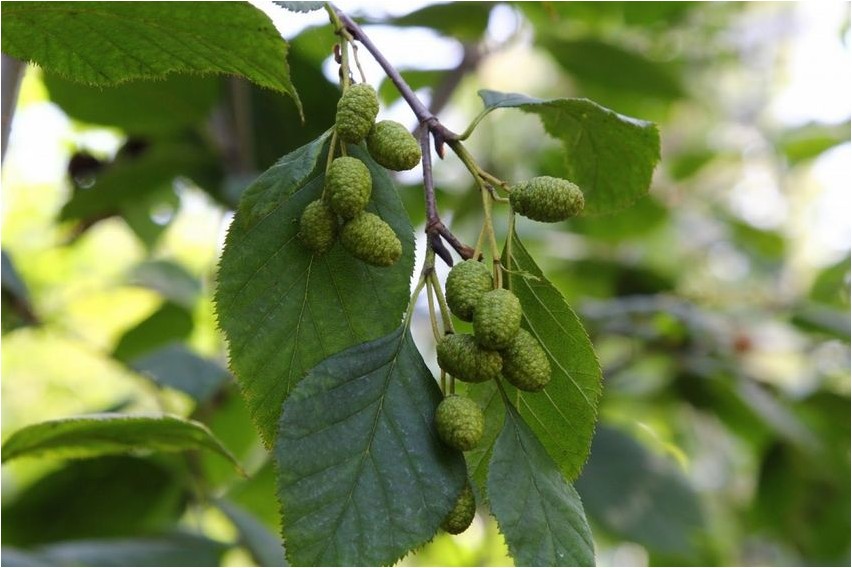
Japanese alder is one of the plants of the birch family; in Latin the name of this plant will be as follows: AInus japonica (Thunb.) Steud.
As for the name of the Japanese alder family itself, in Latin it will be: Betulaceae S. F. Gray.
Description of Japanese alder
Japanese alder is a tree whose height is about fifteen to twenty meters, and its diameter can reach fifty centimeters. The bark of older trees will be dark gray in color, while the young shoots of this plant may be either bare or slightly pubescent. Most Japanese alders are pedunculated; they are resinous and bare. The leaves of Japanese alder can be oblong-lanceolate or narrowly elliptical, and at the very base such leaves will be wedge-shaped and narrowed. The length of the leaves of this plant will be about six to twelve centimeters, and the width will be two to five centimeters. Young leaves of Japanese alder are endowed with very slight pubescence; adult leaves will be dark green in color, shiny on top and lighter below. Such leaves are endowed with beards of hairs located in the corners of the veins; they will be sharply unequal and finely toothed. Japanese alder cones are either oval-oblong or oval, their length will be about one to two centimeters, and their width will be one to one and a half centimeters.
This plant blooms in April until the leaves bloom. Under natural conditions, Japanese alder is found on the territory of Southern Sakhalin, the Kuril Islands, and also in Primorye in the Far East. As for the general distribution, this plant is found in China, Japan and the Korean Peninsula. For growth, Japanese alder prefers marshy areas, lake shores, seaside and river terraces along the sea coast.
Description of the medicinal properties of Japanese alder
Japanese alder is endowed with very valuable healing properties, and it is recommended to use the fruits and bark of this plant for medicinal purposes. The presence of such valuable healing properties should be explained by the content of the triterpenoids taraxerol and betulinic acid in the bark of this plant, as well as phenolic glycosides: hirzutenone and hirzutanol derivatives. The wood of this plant contains the following phenols: alnusone, alnusoxide and alnusonol; the buds contain flavonoids and the triterpenoid p-amirenone. Japanese alder leaves contain hyperoside, sitosterol and triterpenoids.
A decoction prepared from the bark of this plant has a very effective hemostatic effect. A decoction based on Japanese alder seeds is used as a diuretic. It is noteworthy that it has been proven that the extract of the fruit of this plant is endowed with very valuable antibacterial activity.

As a hemostatic agent, it is recommended to use the following very effective remedy based on this plant: to prepare such a healing remedy, you will need to take eight to ten grams of crushed Japanese alder bark per glass of water. It is recommended to boil the resulting healing agent over low heat for about five to six minutes, then this mixture should be infused for one hour, after which this mixture is filtered very carefully. Take the resulting healing remedy based on Japanese alder three to four times a day, two tablespoons, as a hemostatic agent. It should be noted that when used and prepared correctly, such a healing remedy is characterized by a very high degree of effectiveness.





